A lower-friction Estepona day: centre, boulevard and seafront
Use Estepona's explicitly documented accessible routes and facilities to build a conservative day, while keeping seasonal beach assistance live.
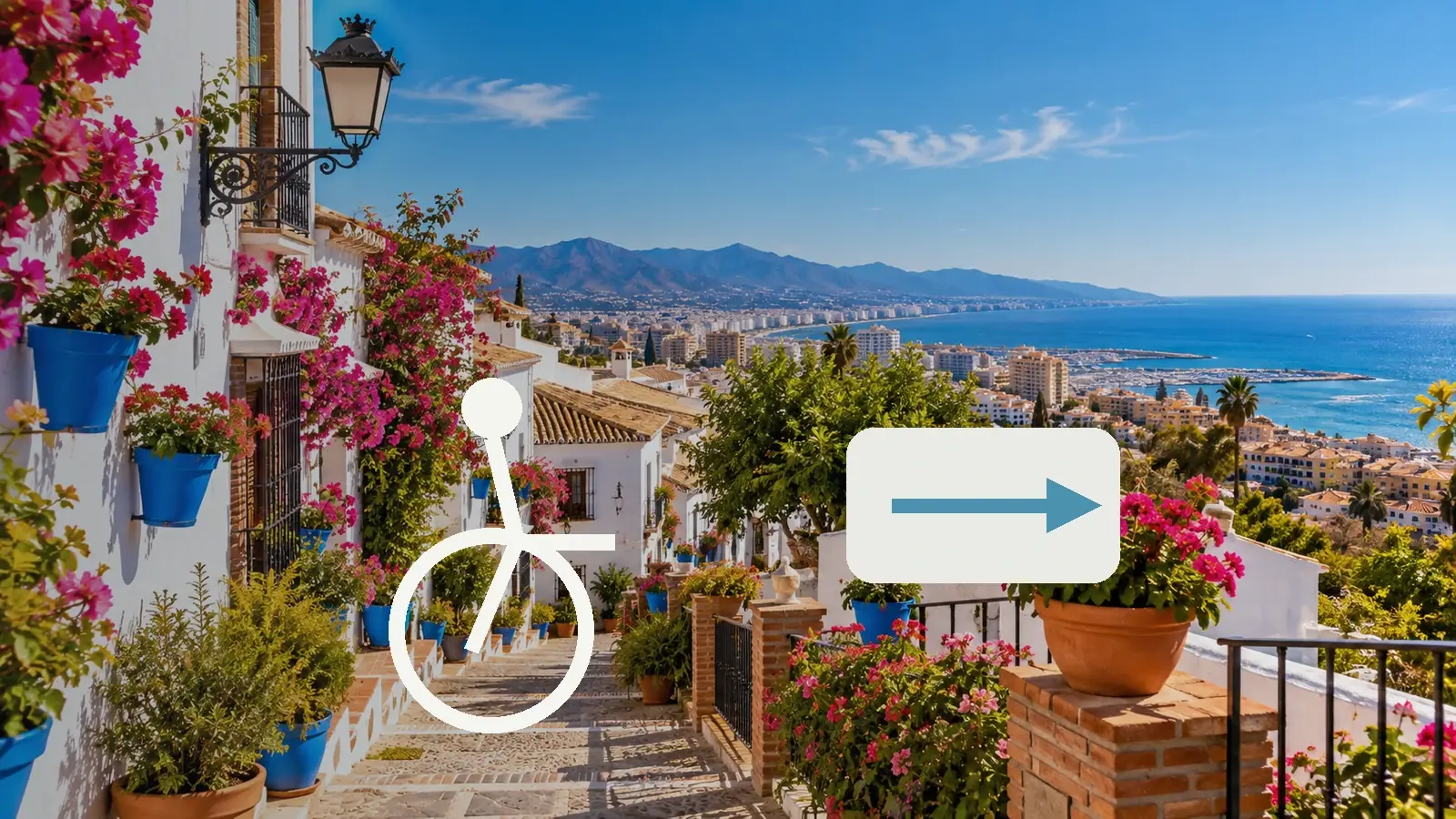
Estepona has unusually strong official accessibility information for a Costa del Sol destination, which makes it possible to build a lower-friction day around evidence rather than assumptions.
The safest structure is to use documented central routes, the Bulevar and the Paseo Marítimo as the stable backbone, then add beach assistance only when the current seasonal service is confirmed.
Start in the historic centre, but stay conservative
Turismo Estepona states that more than 130 renovated streets and plazas in the historic centre are pedestrianised or traffic-restricted.
The same accessibility information identifies several central visitor routes as accessible for people with reduced mobility.
That gives the centre a stronger evidence base than a generic statement such as “the whole Old Town is wheelchair friendly.”
The correct claim is narrower: many renovated streets and public routes have been designed to reduce barriers.
Individual businesses, side streets and private venues still need to be considered separately.
Use the Bulevar as the transition to the sea
The landscaped Bulevar is officially tagged as accessible.
It runs from Calle Terraza in central Estepona towards Punta Doncella and creates a pedestrian connection between the city and waterfront environment.
That makes it a useful transition for a lower-friction day.
Instead of forcing a route through every historic street, you can use the centre first and then move toward the coast through a corridor whose accessibility has been explicitly documented.
The Bulevar gives the day a clear directional structure without needing a complex transfer.
Continue along the Paseo Marítimo
Turismo Estepona also lists the Paseo Marítimo as accessible.
The promenade follows Playa de la Rada toward the port side for roughly three kilometres.
That does not mean every visitor should cover the full distance.
The practical advantage is that the seafront provides a long, documented accessible spine that can be shortened according to energy and needs.
For someone planning conservatively, that is more useful than an ambitious route with multiple uncertain surfaces.
Treat beach access as venue-specific
Estepona's official accessibility page documents assisted bathing at La Rada and El Cristo during the published summer season.
The facilities include adapted equipment such as amphibious chairs, adapted loungers, sand walkers and amphibious crutches.
The Ayuntamiento also installed adapted showers at both beaches for the 2025 season, designed to allow use directly from a wheelchair or amphibious chair.
These are strong, specific accessibility features.
They should not be generalised to every Estepona beach.
Keep assisted bathing seasonal
The assisted-bathing service is not a year-round promise.
Official information describes it as a seasonal service with published dates and staffing.
That means the correct evergreen advice is to check the current beach-season information before relying on it.
The adapted infrastructure at La Rada and El Cristo can still be relevant outside a specific programme period, but staffing, equipment availability and assistance must remain live.
Do not build the day around a service that has not been confirmed for your date.
Avoid blanket accessibility claims
Even strong official accessibility evidence does not justify saying that Estepona is universally step-free.
The historic centre contains many renovated pedestrian streets, but not every private venue has been documented.
The promenade and boulevard are tagged accessible, but that does not automatically extend to every connecting street, beach access point or business.
A useful accessible guide is precise about what is known.
That precision is more valuable than broad reassurance.
The simplest lower-friction route
Begin with the accessible central routes you actually want to see.
Use the Bulevar as the transition toward the sea.
Continue along the Paseo Marítimo for as much or as little distance as suits the group.
If assisted bathing is important, check the current service at La Rada or El Cristo before leaving.
This creates a conservative Estepona day based on documented lower-barrier infrastructure rather than optimistic assumptions.
The stable route is centre + Bulevar + seafront. The seasonal layer is beach assistance.
That distinction also makes the plan easier to adapt. If beach assistance is not operating on the visit date, the documented accessible centre, boulevard and promenade still provide a complete lower-friction route.
Continue your Costa del Sol planning
Other published guides for the same destination or a closely related topic.