Accessible accommodation on the Costa del Sol: how to verify a hotel before booking
Finding genuinely accessible accommodation on the Costa del Sol requires more than filtering for the word “accessible”.
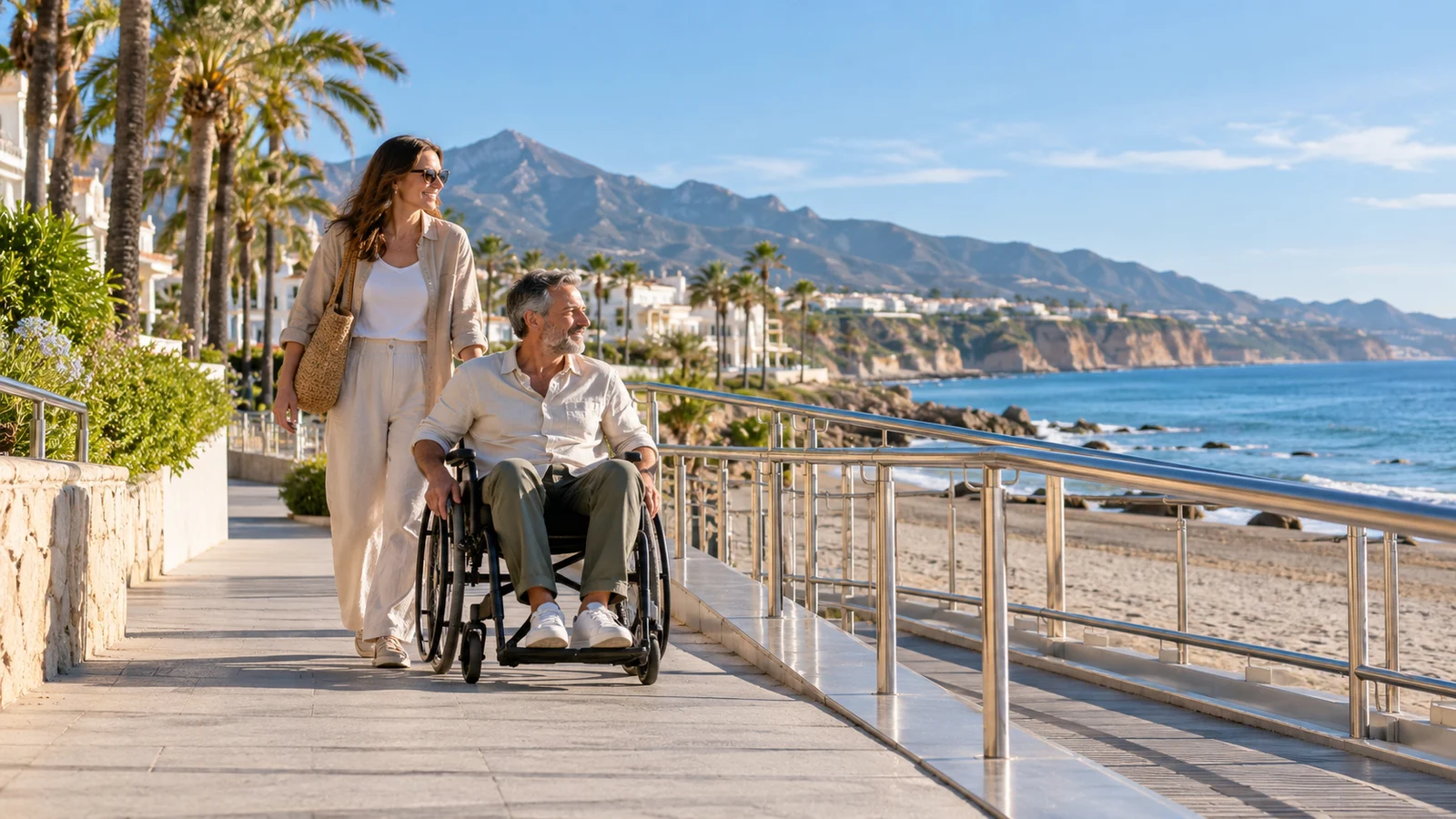
A hotel can have step-free reception but an unsuitable bathroom. It can offer an adapted room but have a pool reached only by steps. It can have an accessible entrance but a steep pavement outside. The useful question is therefore not “is this hotel accessible?” but “does this exact room and route work for this traveller?”
The Junta de Andalucía maintains an Accessible Tourist Destinations platform with evaluated resources, including accommodation in Málaga province. Its current database includes examples such as ILUNION Málaga and Gran Meliá Don Pepe in Marbella, with accessibility assessments rather than a simple yes/no label.
Use that same approach when you book: verify individual features rather than relying on marketing language.
Quick answer
Before paying, confirm the exact room and ask about:
- step-free route from street or parking to reception;
- lift dimensions and access to your floor;
- bedroom door width and circulation space;
- bed height if transfers matter;
- bathroom doorway;
- roll-in shower or bath;
- shower seat and grab rails;
- toilet height and side-transfer space;
- basin clearance;
- emergency alarm;
- pool and restaurant access;
- accessible parking;
- route from hotel to the surrounding streets.
Ask for current photos of the exact adapted room whenever possible.
“Accessible” is not one standard experience
Accessibility needs differ.
A wheelchair user may care about turning space and lateral toilet transfer.
A traveller using crutches may mainly need lifts, handrails and short walking distances.
Someone with visual impairment may care about contrast, tactile information and obstacle-free circulation.
A deaf traveller may need visual alarms or communication support.
Do not let a single hotel checkbox stand in for these differences.
Use assessed resources as evidence, not as a guarantee
The Junta de Andalucía’s accessible-tourism platform evaluates specific tourism resources against multiple criteria.
Its current accommodation listings include ILUNION Málaga and Gran Meliá Don Pepe in Marbella among Málaga-province examples.
This is useful because an assessment provides more structure than an unverified booking-site icon.
But even an official assessment should not replace confirmation of the exact room you are booking. Hotels renovate, room inventory changes and a property may have only a small number of adapted units.
Ask for the exact adapted room type
Do not accept “yes, we are accessible” as the final answer.
Ask:
- What is the exact room category?
- How many adapted rooms exist?
- Is the adapted room guaranteed in the reservation or only requested?
- Is it twin, double or another configuration?
- Is the bathroom the same in all adapted rooms?
- Can the hotel send current photos?
A booking note is not always the same as a guaranteed room allocation.
If the feature is essential, get written confirmation.
Bathroom: the highest-priority check
Bathrooms are where vague accessibility claims most often fail.
Ask specifically about:
- shower or bath;
- level-access shower;
- fixed or movable shower seat;
- grab-rail positions;
- toilet height;
- space beside the toilet;
- basin height;
- mirror height;
- emergency pull cord or alarm;
- whether the bathroom floor becomes slippery.
“Adapted bathroom” can still mean very different layouts.
If transfers are important, photos and measurements are much more useful than descriptive adjectives.
Bedroom layout
Check whether there is enough space to reach both sides of the bed if needed.
Ask about:
- clear route from door to bed;
- space for wheelchair turning;
- bed height;
- whether furniture can be moved;
- balcony threshold;
- wardrobe rail height;
- power sockets near the bed.
A large room is not automatically usable if furniture blocks the transfer route.
Entrance and reception
The journey begins before the room.
Verify:
- step-free entrance;
- ramp gradient if there is a ramp;
- automatic or easy-to-open door;
- kerb between drop-off point and entrance;
- reception counter accessibility;
- seating while checking in.
If arriving by adapted taxi, ask where the vehicle can stop.
Lifts
A hotel with lifts is not automatically wheelchair accessible.
Ask for:
- lift door width;
- internal dimensions;
- whether all guest facilities are served;
- whether a mobility scooter fits;
- whether there are steps between lift and room;
- whether the lift is available 24 hours.
Older buildings can have lifts that are too small for some powered chairs.
Parking
If you drive, accessible parking can determine whether the hotel works at all.
Ask:
- how many adapted bays there are;
- whether they can be reserved;
- distance to the entrance;
- surface and slope;
- height limits in underground parking;
- whether lift access connects the garage directly to reception.
A blue-badge space several streets away may not solve the problem.
Pool access
A hotel may describe the property as accessible while the pool remains unusable for a wheelchair user.
Ask whether the pool has:
- ramp;
- hoist;
- transfer steps with rails;
- level route to the pool deck;
- accessible changing/toilet facilities nearby.
Do not infer pool accessibility from photographs of a flat pool terrace.
Restaurant and breakfast
Check whether the restaurant is on a step-free route.
Ask about:
- table height and clearance;
- buffet reach;
- whether staff can assist at a buffet;
- accessible toilets near the restaurant;
- terrace thresholds.
Breakfast can become unnecessarily difficult if the adapted room is good but the dining area is not.
The area outside the hotel matters
A technically accessible hotel can still be a poor choice if the surrounding streets are steep or broken.
Costa del Sol destinations vary a lot.
Málaga city and central Fuengirola can offer flatter urban routes in many areas.
Parts of Benalmádena, Mijas, Torremolinos and Marbella include slopes depending on the neighbourhood.
Do not choose only by hotel; examine the route to:
- beach;
- station;
- bus stop;
- restaurants;
- promenade;
- attractions you actually plan to use.
See the accessible Costa del Sol guide and accessible public transport guide.
Beach access
If accessible beach use matters, choose accommodation based on the exact beach service, not simply distance to the sea.
Accessible beach facilities can be seasonal.
A hotel 100 metres from the coast is not automatically better than one 500 metres away if the route is steep or the nearest accessible bathing point is elsewhere.
See the accessible beaches guide.
Public transport
If you do not drive, transport should be part of the hotel decision.
Check whether the route from the hotel to the train or bus stop is genuinely usable.
A station may be accessible while the pavement between hotel and station is not.
For airport arrival, ask whether the hotel has experience receiving wheelchair-accessible transfers and whether the drop-off point is step-free.
Málaga as a possible base
The Junta’s accessible-tourism database currently includes ILUNION Málaga with a detailed assessment.
That does not make it the automatic best choice for every traveller.
Its value as an example is that the property appears in an official accessibility-assessment system.
If Málaga city fits your itinerary, compare the exact adapted room with your personal checklist before booking.
Marbella as a possible base
The same Junta platform currently lists Gran Meliá Don Pepe in Marbella with an accessibility assessment.
Again, use that as evidence to investigate rather than a blanket guarantee.
Marbella is geographically spread out, so also check the route from the hotel to the promenade, old town, transport and any specific beach service you want.
Booking through an OTA
Booking platforms are useful for finding inventory, but accessibility filters are not enough on their own.
A platform may label the hotel, not the specific room.
After selecting a property:
- read the room description;
- contact the hotel directly;
- confirm the exact adapted room;
- keep the written confirmation;
- verify again shortly before travel if the feature is critical.
Do not assume a generic “special request” guarantees allocation.
What to put in your message to the hotel
Send a concise checklist.
For example:
- I use a wheelchair measuring X cm wide.
- I need step-free access from entrance to room.
- I need a roll-in shower.
- I need transfer space on the right/left side of the toilet.
- I need bed height around X cm.
- I need an accessible route to breakfast.
- Please confirm the exact room category and send current bathroom photos.
Specific questions produce better answers.
Travelling with a mobility scooter
Check:
- lift size;
- charging policy;
- where the scooter can be stored;
- fire-safety restrictions;
- step-free entrance;
- route to your room;
- whether the scooter is allowed in restaurants or must be parked outside.
Large scooters can create issues even where manual wheelchairs fit comfortably.
Sensory accessibility
Physical access is only one part of accessibility.
Travellers may also need:
- visual fire alarms;
- vibrating alarm options;
- hearing loops;
- low-allergen rooms;
- quiet-room placement;
- clear signage;
- assistance with written or spoken communication.
Ask directly if these features are essential.
Do not rely on star rating
Hotel stars describe category and services, not how well a property fits a particular disability.
A simpler hotel with the right adapted room may work better than a luxury resort with difficult internal routes.
Choose function first.
Legal requirements are a baseline, not your personal checklist
Andalusian hotel regulations include accessibility obligations, and the Junta publishes a practical accessibility guide for tourism businesses.
That legal framework matters, but compliance does not mean every hotel is equally suitable for every traveller.
Your own transfer, mobility, sensory and support needs remain the deciding factor.
A practical booking sequence
- Choose the destination area.
- Check surrounding slopes and transport.
- Find properties with credible accessibility information.
- Compare assessed resources where available.
- Contact the hotel directly.
- Confirm the exact room.
- Request photos and measurements for critical features.
- Save the written confirmation.
- Confirm accessible transport from airport if needed.
- Recheck shortly before arrival.
This reduces the risk of discovering a barrier after check-in.
Red flags
Be cautious if a property:
- cannot identify the adapted room type;
- refuses to provide photos;
- says “wheelchair friendly” but cannot describe the bathroom;
- treats an accessibility request as a non-guaranteed preference;
- cannot explain the route from entrance to room;
- gives contradictory answers between booking platform and hotel.
If a feature is essential, ambiguity is a reason to choose another property.
Before you pay
Confirm in writing:
- exact room category;
- bathroom setup;
- step-free route;
- lift;
- parking or transfer drop-off;
- restaurant access;
- any pool requirement;
- surrounding route if the hotel has reliable local knowledge;
- cancellation terms.
Accessibility is too important to leave to a checkbox.
Sources
- Junta de Andalucía — Destinos Turísticos Accesibles en Andalucía, accommodation assessments including Málaga-province properties.
- Junta de Andalucía — practical accessibility guide for the tourism sector.
- Junta de Andalucía — Andalucía Accesible / TUR4all resource-evaluation programme.
- Andalusian hotel regulations — accessibility requirements for hotel establishments.
Hotel facilities and room allocation can change. Confirm the exact room and essential features directly before booking.
Continue your Costa del Sol planning
Other published guides for the same destination or a closely related topic.