Accessible Estepona: Old Town, promenade, beaches and practical mobility
Estepona is one of the easier Costa del Sol towns to consider for travellers with reduced mobility, but the useful question is still route-specific: can you move comfortably between your accommodation, promenade, beach, restaurants and transport? The strongest areas are the renovated historic centre, the seafront around La Rada and the adapted bathing points at La Rada and El Cristo. Outside those areas, longer distances and resort layouts can change the experience considerably. ## Quick answer Estepona can be a strong choice if you: - stay near the centre or promenade; - check the exact hotel entrance and bathroom; - use La Rada or El Cristo when adapted beach access matters; - confirm assisted-bathing dates before travel; - plan taxis for longer resort-to-centre journeys; - avoid assuming every historic or resort street is equally easy. ## Historic centre Estepona Tourism states that more than 130 streets and squares in the historic centre have been renovated as pedestrian or traffic-restricted spaces and describes the area as accessible for people with reduced mobility. That is unusually useful for visitors because the centre contains restaurants, cafés, shops and several of the town's urban routes. It means a central stay can reduce the number of difficult transfers during the day. ## Accessible urban routes The municipality also promotes its Mural Route, Poetry Route, Sculpture Route and Charming Places Route as accessible. That creates a good alternative to a trip based only around beaches. You can plan shorter cultural loops through the town and return to the hotel without needing a car. One example highlighted by Turismo Estepona is the “Agua” mural on Calle Málaga, which includes Braille relief. ## Promenade The seafront is one of Estepona's strongest practical assets. A promenade-based day is usually easier to understand than a route through multiple steep or fragmented neighbourhoods. For a traveller using a wheelchair, rollator or cane, staying close to the promenade can make it easier to combine: - breakfast; - beach; - lunch; - rest; - evening walk. Still check the route from hotel entrance to promenade because a short map distance can include kerbs, garage ramps or construction. ## La Rada beach La Rada is the main urban beach and one of the key adapted beach points. Estepona Tourism states that during the summer there is a daily assisted-bathing service for people with reduced mobility at the Avenida Juan Carlos I module. The service includes adapted equipment such as: - amphibious chairs; - adapted sun loungers; - sand walkers; - amphibious crutches. Widened walkways also help wheelchair access across the sand. ## El Cristo beach El Cristo is the other important assisted-bathing point listed by the municipality. It offers the same general concept of staff support and adapted equipment during the seasonal service. Because El Cristo is a smaller beach environment than La Rada, some travellers may prefer it for a more contained beach day. The exact access route and parking should still be checked before travelling. ## Assisted bathing is seasonal Do not treat adapted bathing as a permanent year-round service. The official information describes the staffed service as a summer operation. Before travel, confirm: - current start/end dates; - operating hours; - whether booking is required; - available equipment; - sea conditions; - exact meeting point. Permanent walkways and adapted facilities do not guarantee that human assistance is operating that day. ## Shade and fatigue Estepona's accessibility information also notes shaded areas for people with mobility difficulties. That matters because heat can be as limiting as a step. In summer, plan: - shorter routes; - morning/evening activity; - shaded rest points; - water; - a taxi backup. A route that is manageable at 09:00 can be exhausting at 15:00. ## Accommodation Confirm the exact room, not only the hotel's generic accessibility label. Ask: - Is the entrance step-free? - Is there a lift? - What are the lift dimensions? - Is the adapted room guaranteed? - Is the shower level-access? - Are grab rails fitted? - Is there side-transfer space at the toilet? - Can the hotel send current photos? - Is the route to breakfast/pool/parking step-free? The best location is one that makes the repeated daily routes easy. ## Centre or resort zone? For independent mobility, central Estepona is usually easier to evaluate. Outer resort zones can be excellent, but distances to shops, restaurants or the town centre may be much longer. If you book a resort, check: - internal gradients; - lift coverage; - accessible pool route; - restaurant access; - taxi pickup; - distance to the nearest usable beach access point. A technically accessible room can still sit inside an inconvenient overall layout. ## Public transport Estepona does not have Cercanías. Bus and taxi therefore matter more than in Fuengirola or Málaga. The municipal accessibility information lists local bus lines and identifies urban transport as part of the accessible visitor context. For a specific journey, verify: - the exact stop; - kerb height; - vehicle accessibility; - space for a wheelchair; - route from stop to destination. The last few hundred metres often determine whether the journey is practical. ## Taxi and adapted vehicle Taxi can remove the difficult part of a route, especially between resorts, the centre and beaches. If you need a wheelchair-accessible vehicle, reserve rather than relying on immediate availability. Tell the operator: - wheelchair type; - whether you remain seated; - dimensions/weight if relevant; - passenger count; - luggage. For powered chairs or large scooters, confirm vehicle capacity in advance. ## Wheelchairs For wheelchair users, prioritise: - hotel entrance; - bathroom; - promenade access; - adapted beach point; - taxi backup. Manual wheelchair users should pay particular attention to long distances and slopes. Powered wheelchair users should check lift sizes, charging and vehicle loading. ## Rollators and canes Estepona can work very well for travellers who can walk short distances but need regular rests. A central promenade-based stay allows many days to be broken into small sections. Choose accommodation near: - cafés; - seating; - restaurants; - promenade; - pharmacy; - beach. Avoid itineraries that require repeated long crossings of the municipality. ## Visual accessibility Accessibility is not only about mobility. The municipality's accessible routes include features such as Braille relief at the “Agua” mural. Travellers with visual impairment should also check: - tactile guidance at transport points; - audio/visual information; - hotel lift controls; - crossing signals; - assistance availability. Confirm any essential feature directly. ## Hearing accessibility If visual information is important, check whether: - hotel alarms have visual support; - transport information appears on screens; - attractions can provide written instructions. Save important booking confirmations and contact details on your phone. ## Accessible toilets Do not rely only on online map icons. Confirm toilets at the specific beach, attraction or venue. Seasonal beach facilities may have different operating periods. For a longer day, plan toilet and rest points before leaving. ## Parking If you drive, ask the accommodation whether an accessible bay can be reserved. Also check: - distance to entrance; - surface; - gradient; - lift access; - garage height; - route from bay to room. At the beach, use the exact adapted access point rather than assuming every nearby parking space connects to a usable walkway. ## A practical accessible day A low-friction day might be: - breakfast near the hotel; - short accessible Old Town route; - rest; - La Rada adapted beach point; - lunch nearby; - hotel break during peak heat; - evening promenade walk. The goal is not to maximise distance. It is to minimise unnecessary barriers. ## When Estepona is a strong choice Estepona can be particularly suitable if you value: - renovated pedestrian centre; - long seafront routine; - adapted summer beach services; - a larger town with many daily services; - fewer steep repeated routes than hillier destinations. ## When another base may be easier Consider Málaga or Fuengirola if direct rail is essential. Consider a resort with verified full-site accessibility if you prefer to minimise movement through public streets. The best destination depends on the exact mobility needs, not a general accessibility label. ## Before booking Confirm: 1. hotel entrance and bathroom; 2. route to promenade; 3. adapted beach point; 4. assisted-bathing dates; 5. taxi/vehicle needs; 6. local bus stop; 7. accessible toilets; 8. heat/rest strategy; 9. parking if driving; 10. any sensory-access requirements. ## Sources - Turismo Estepona — Accessibility Information. - Turismo Estepona — Estepona, Ciudad Accesible. - Turismo Estepona — official destination and beach information. Accessibility services and seasonal assistance can change. Confirm current details before travelling.
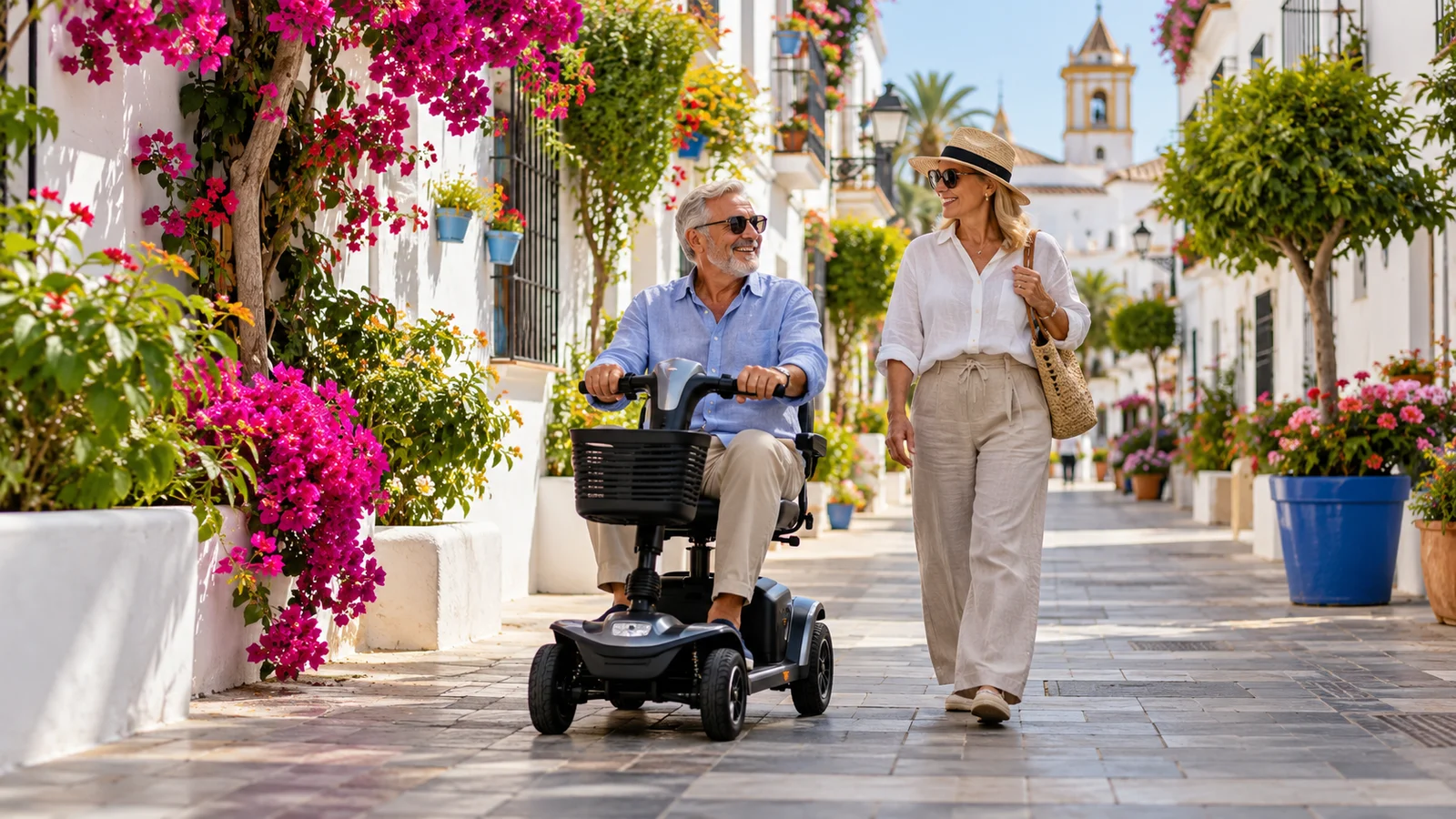
Estepona is one of the easier Costa del Sol towns to consider for travellers with reduced mobility, but the useful question is still route-specific: can you move comfortably between your accommodation, promenade, beach, restaurants and transport?
The strongest areas are the renovated historic centre, the seafront around La Rada and the adapted bathing points at La Rada and El Cristo. Outside those areas, longer distances and resort layouts can change the experience considerably.
Quick answer
Estepona can be a strong choice if you:
- stay near the centre or promenade;
- check the exact hotel entrance and bathroom;
- use La Rada or El Cristo when adapted beach access matters;
- confirm assisted-bathing dates before travel;
- plan taxis for longer resort-to-centre journeys;
- avoid assuming every historic or resort street is equally easy.
Historic centre
Estepona Tourism states that more than 130 streets and squares in the historic centre have been renovated as pedestrian or traffic-restricted spaces and describes the area as accessible for people with reduced mobility.
That is unusually useful for visitors because the centre contains restaurants, cafés, shops and several of the town's urban routes.
It means a central stay can reduce the number of difficult transfers during the day.
Accessible urban routes
The municipality also promotes its Mural Route, Poetry Route, Sculpture Route and Charming Places Route as accessible.
That creates a good alternative to a trip based only around beaches.
You can plan shorter cultural loops through the town and return to the hotel without needing a car.
One example highlighted by Turismo Estepona is the “Agua” mural on Calle Málaga, which includes Braille relief.
Promenade
The seafront is one of Estepona's strongest practical assets.
A promenade-based day is usually easier to understand than a route through multiple steep or fragmented neighbourhoods.
For a traveller using a wheelchair, rollator or cane, staying close to the promenade can make it easier to combine:
- breakfast;
- beach;
- lunch;
- rest;
- evening walk.
Still check the route from hotel entrance to promenade because a short map distance can include kerbs, garage ramps or construction.
La Rada beach
La Rada is the main urban beach and one of the key adapted beach points.
Estepona Tourism states that during the summer there is a daily assisted-bathing service for people with reduced mobility at the Avenida Juan Carlos I module.
The service includes adapted equipment such as:
- amphibious chairs;
- adapted sun loungers;
- sand walkers;
- amphibious crutches.
Widened walkways also help wheelchair access across the sand.
El Cristo beach
El Cristo is the other important assisted-bathing point listed by the municipality.
It offers the same general concept of staff support and adapted equipment during the seasonal service.
Because El Cristo is a smaller beach environment than La Rada, some travellers may prefer it for a more contained beach day.
The exact access route and parking should still be checked before travelling.
Assisted bathing is seasonal
Do not treat adapted bathing as a permanent year-round service.
The official information describes the staffed service as a summer operation.
Before travel, confirm:
- current start/end dates;
- operating hours;
- whether booking is required;
- available equipment;
- sea conditions;
- exact meeting point.
Permanent walkways and adapted facilities do not guarantee that human assistance is operating that day.
Shade and fatigue
Estepona's accessibility information also notes shaded areas for people with mobility difficulties.
That matters because heat can be as limiting as a step.
In summer, plan:
- shorter routes;
- morning/evening activity;
- shaded rest points;
- water;
- a taxi backup.
A route that is manageable at 09:00 can be exhausting at 15:00.
Accommodation
Confirm the exact room, not only the hotel's generic accessibility label.
Ask:
- Is the entrance step-free?
- Is there a lift?
- What are the lift dimensions?
- Is the adapted room guaranteed?
- Is the shower level-access?
- Are grab rails fitted?
- Is there side-transfer space at the toilet?
- Can the hotel send current photos?
- Is the route to breakfast/pool/parking step-free?
The best location is one that makes the repeated daily routes easy.
Centre or resort zone?
For independent mobility, central Estepona is usually easier to evaluate.
Outer resort zones can be excellent, but distances to shops, restaurants or the town centre may be much longer.
If you book a resort, check:
- internal gradients;
- lift coverage;
- accessible pool route;
- restaurant access;
- taxi pickup;
- distance to the nearest usable beach access point.
A technically accessible room can still sit inside an inconvenient overall layout.
Public transport
Estepona does not have Cercanías.
Bus and taxi therefore matter more than in Fuengirola or Málaga.
The municipal accessibility information lists local bus lines and identifies urban transport as part of the accessible visitor context.
For a specific journey, verify:
- the exact stop;
- kerb height;
- vehicle accessibility;
- space for a wheelchair;
- route from stop to destination.
The last few hundred metres often determine whether the journey is practical.
Taxi and adapted vehicle
Taxi can remove the difficult part of a route, especially between resorts, the centre and beaches.
If you need a wheelchair-accessible vehicle, reserve rather than relying on immediate availability.
Tell the operator:
- wheelchair type;
- whether you remain seated;
- dimensions/weight if relevant;
- passenger count;
- luggage.
For powered chairs or large scooters, confirm vehicle capacity in advance.
Wheelchairs
For wheelchair users, prioritise:
- hotel entrance;
- bathroom;
- promenade access;
- adapted beach point;
- taxi backup.
Manual wheelchair users should pay particular attention to long distances and slopes.
Powered wheelchair users should check lift sizes, charging and vehicle loading.
Rollators and canes
Estepona can work very well for travellers who can walk short distances but need regular rests.
A central promenade-based stay allows many days to be broken into small sections.
Choose accommodation near:
- cafés;
- seating;
- restaurants;
- promenade;
- pharmacy;
- beach.
Avoid itineraries that require repeated long crossings of the municipality.
Visual accessibility
Accessibility is not only about mobility.
The municipality's accessible routes include features such as Braille relief at the “Agua” mural.
Travellers with visual impairment should also check:
- tactile guidance at transport points;
- audio/visual information;
- hotel lift controls;
- crossing signals;
- assistance availability.
Confirm any essential feature directly.
Hearing accessibility
If visual information is important, check whether:
- hotel alarms have visual support;
- transport information appears on screens;
- attractions can provide written instructions.
Save important booking confirmations and contact details on your phone.
Accessible toilets
Do not rely only on online map icons.
Confirm toilets at the specific beach, attraction or venue.
Seasonal beach facilities may have different operating periods.
For a longer day, plan toilet and rest points before leaving.
Parking
If you drive, ask the accommodation whether an accessible bay can be reserved.
Also check:
- distance to entrance;
- surface;
- gradient;
- lift access;
- garage height;
- route from bay to room.
At the beach, use the exact adapted access point rather than assuming every nearby parking space connects to a usable walkway.
A practical accessible day
A low-friction day might be:
- breakfast near the hotel;
- short accessible Old Town route;
- rest;
- La Rada adapted beach point;
- lunch nearby;
- hotel break during peak heat;
- evening promenade walk.
The goal is not to maximise distance. It is to minimise unnecessary barriers.
When Estepona is a strong choice
Estepona can be particularly suitable if you value:
- renovated pedestrian centre;
- long seafront routine;
- adapted summer beach services;
- a larger town with many daily services;
- fewer steep repeated routes than hillier destinations.
When another base may be easier
Consider Málaga or Fuengirola if direct rail is essential.
Consider a resort with verified full-site accessibility if you prefer to minimise movement through public streets.
The best destination depends on the exact mobility needs, not a general accessibility label.
Before booking
Confirm:
- hotel entrance and bathroom;
- route to promenade;
- adapted beach point;
- assisted-bathing dates;
- taxi/vehicle needs;
- local bus stop;
- accessible toilets;
- heat/rest strategy;
- parking if driving;
- any sensory-access requirements.
Sources
- Turismo Estepona — Accessibility Information.
- Turismo Estepona — Estepona, Ciudad Accesible.
- Turismo Estepona — official destination and beach information.
Accessibility services and seasonal assistance can change. Confirm current details before travelling.
Continue your Costa del Sol planning
Other published guides for the same destination or a closely related topic.