Accessible public transport on the Costa del Sol: train, Metro, bus and transfer planning
Accessible public transport on the Costa del Sol is possible, but the experience depends on the exact station, vehicle, stop and final route. The strongest accessible public-transport corridor is Málaga–Torremolinos–Benalmádena–Fuengirola because it combines Renfe Cercanías C1 with urban transport. Málaga city adds a Metro network designed around universal accessibility, while EMT Málaga states that its full urban bus fleet is equipped with ramps for people with reduced mobility. The main planning rule is simple: do not check only whether the vehicle is accessible. Check the complete chain from hotel door to platform, vehicle, destination stop and final pavement. ## Quick answer For many travellers with reduced mobility: - **Málaga city** offers the strongest mix of accessible Metro, urban bus and rail. - **Torremolinos, Benalmádena and Fuengirola** benefit from C1 rail, but individual stations and surrounding gradients differ. - **Marbella and Estepona** rely more on intercity and local buses because there is no Cercanías line. - **Nerja** also depends more heavily on buses and transfers. Always confirm current accessibility for the exact journey before travelling. ## Renfe Cercanías C1 C1 is the most important rail line for visitors because it connects Málaga, Málaga Airport, Torremolinos, Benalmádena and Fuengirola. Renfe continues to invest in accessibility across the Málaga network. In July 2026, Renfe began works to improve accessibility and lighting at Torreblanca and Montemar Alto and announced improvements at five Málaga Cercanías stations, including Málaga Centro Alameda, Victoria Kent and Plaza Mayor. This is important because station accessibility is not static. Works and temporary routes can affect the journey. ## Check the exact station Do not assume every C1 station has identical access. Before travelling, verify: - lift or ramp availability; - platform access; - temporary works; - assistance needs; - accessible ticketing; - route from street to platform. A station can technically be accessible while the pavement outside remains steep or difficult. This matters particularly in hillier parts of Torremolinos and Benalmádena. ## Málaga Airport by train C1 provides direct rail between Málaga Airport and Málaga city, Torremolinos, Benalmádena and Fuengirola. For travellers with mobility needs, this can remove the need for a private airport transfer. But check your final hotel route. A direct train is not automatically the easiest choice if the station is uphill from your accommodation or the route includes difficult pavements. ## Metro de Málaga Metro de Málaga provides one of the clearest accessibility systems in the region. Its 2025 service charter states that accessibility is managed under UNE 170001-2:2007 and that stations and trains are designed to remove architectural barriers. The Metro also states that customer-facing facilities are accessible, including: - lifts; - ticket machines; - gates; - intercoms; - tactile guidance; - platform-to-train access suitable for wheelchairs and pushchairs. This makes the Metro particularly useful for city-based visitors. ## Visual and hearing accessibility on the Metro Accessibility is not limited to wheelchairs. Metro de Málaga reports: - visual information; - audible information; - tactile routes; - adapted ticketing; - accessible intercoms. Its sustainability report also highlights visual screens and audio announcements for passengers with sensory disabilities. Travellers with specific sensory requirements should still check the current station and service information before travel. ## EMT Málaga urban buses EMT Málaga states that 100% of its fleet is equipped with ramps for people with reduced mobility. Its sustainability information also describes: - kneeling systems on buses; - step-free routes from the central door to reserved spaces; - optical and audible information; - Braille stop buttons; - visual and acoustic stop requests. This makes Málaga city one of the strongest bus environments on the Costa del Sol. ## Visual-accessibility support on EMT EMT Málaga also provides an accessibility function for blind or visually impaired users. The system can allow a registered user to request that a bus stop for pickup without needing to visually identify the approaching line. The operator also describes audio information and high-visibility displays at stops. This can be extremely useful for independent travel. ## Intercity buses Intercity travel is more variable than Metro or Málaga urban bus. Some operators and routes explicitly identify PMR-accessible services, but accessibility can depend on: - vehicle; - timetable; - luggage compartment; - wheelchair type; - advance booking; - stop design. For example, Avanza currently marks some Málaga–Estepona services as PMR bus services. Do not assume every departure uses the same accessible vehicle. Confirm the exact service. ## Marbella and Estepona Because Marbella and Estepona have no Cercanías station, buses and transfers are more important. For wheelchair users, contact the operator before travel and ask: - whether the specific departure accepts a wheelchair; - whether boarding is by lift/ramp; - whether transfer from chair is required; - whether powered chairs are accepted; - battery restrictions; - advance notice; - accessible stop at destination. A coach may be accessible while the stop environment is not. ## Nerja Nerja also relies more heavily on bus and road transport. If mobility is limited, compare intercity bus with a prebooked adapted transfer. The deciding factor may be the final route from Nerja bus stop to accommodation, especially because parts of the town are hilly. ## Málaga Bus Station Málaga Bus Station publishes several accessibility features, including: - adapted information counters and ticket offices; - tactile guidance; - Braille platform numbering; - high-visibility information; - digital public-address systems; - accessible toilet. That makes the station a stronger interchange point for travellers with visual or mobility needs. Still check the accessibility of the specific coach. ## Taxi and adapted taxi Taxi can be useful for the “last kilometre”. This is especially relevant when: - the station is accessible but the hotel is uphill; - the bus stop is too far; - luggage makes independent movement difficult; - the traveller uses a wheelchair. If a wheelchair-accessible taxi is essential, prebook rather than relying on immediate street availability. ## Private adapted transfer A private adapted transfer can be the best choice for: - powered wheelchair users; - large mobility scooters; - airport arrivals; - families with several bags; - late-night arrivals; - destinations without rail. Confirm the vehicle configuration in writing. Ask whether you remain seated in the wheelchair or transfer to a vehicle seat. ## Mobility scooters Mobility scooters can be more complicated than manual wheelchairs because of size and battery type. Before using public transport, check: - dimensions; - weight; - battery; - lift capacity; - allowed position; - turning space. Do not assume that a service accepting manual wheelchairs automatically accepts every scooter. ## Travelling with a walker For a walker or rollator, the key issues are often: - step-free boarding; - lift availability; - room to store or hold the device; - station seating; - distance between connections. Metro and urban bus may be straightforward, but long interchanges can still be tiring. ## Travelling with visual impairment Useful features may include: - tactile paving; - audio announcements; - Braille; - high-contrast signage; - app-based stop support. Metro de Málaga and EMT Málaga provide several of these systems. For an unfamiliar route, plan the interchange points in advance. ## Travelling with hearing impairment Look for: - visual platform information; - screens inside vehicles; - written disruption information; - visual stop indicators. When assistance is essential, save the operator's customer-service contact before travel. ## Temporary lifts and works This is one of the biggest risks in accessible travel. A journey that is normally step-free can become difficult if: - a lift fails; - an entrance closes; - a platform route changes; - construction blocks the pavement. Renfe’s 2026 station works show why checking current service information matters. Always review disruptions shortly before departure. ## The final 500 metres The final route often matters more than the train. Check: - slope; - kerbs; - pavement; - crossings; - steps; - lighting; - hotel entrance. This is particularly important in Torremolinos, Benalmádena and Nerja. A taxi for the last section can make an otherwise accessible journey practical. ## Airport strategy If staying on C1, train may be easiest. If staying in Marbella, Estepona, Mijas inland or Nerja, compare: - coach; - adapted taxi; - private transfer. Do not choose purely by price. A slightly more expensive transfer may remove multiple transfers and reduce risk. ## Plan B For essential journeys, have a backup. Save: - taxi number; - operator customer service; - hotel reception; - alternative stop; - private transfer contact. Accessibility problems are much easier to manage when you already know the fallback. ## Before travelling Confirm: 1. exact station/stop; 2. lift/ramp status; 3. accessible vehicle; 4. advance-booking requirements; 5. wheelchair/scooter rules; 6. assistance; 7. final pavement; 8. taxi backup; 9. current disruptions; 10. return journey. ## Sources - Metro de Málaga — 2025 Service Charter and universal-accessibility information. - EMT Málaga — accessibility systems and 100% ramp-equipped fleet. - Renfe — 2026 accessibility works at Málaga Cercanías stations. - Estación de Autobuses de Málaga — accessible counters, tactile guidance, Braille and PMR facilities. - Avanza — current PMR-marked intercity services on Málaga–Estepona routes. Accessibility and vehicle assignments can change. Confirm the exact service before travel.
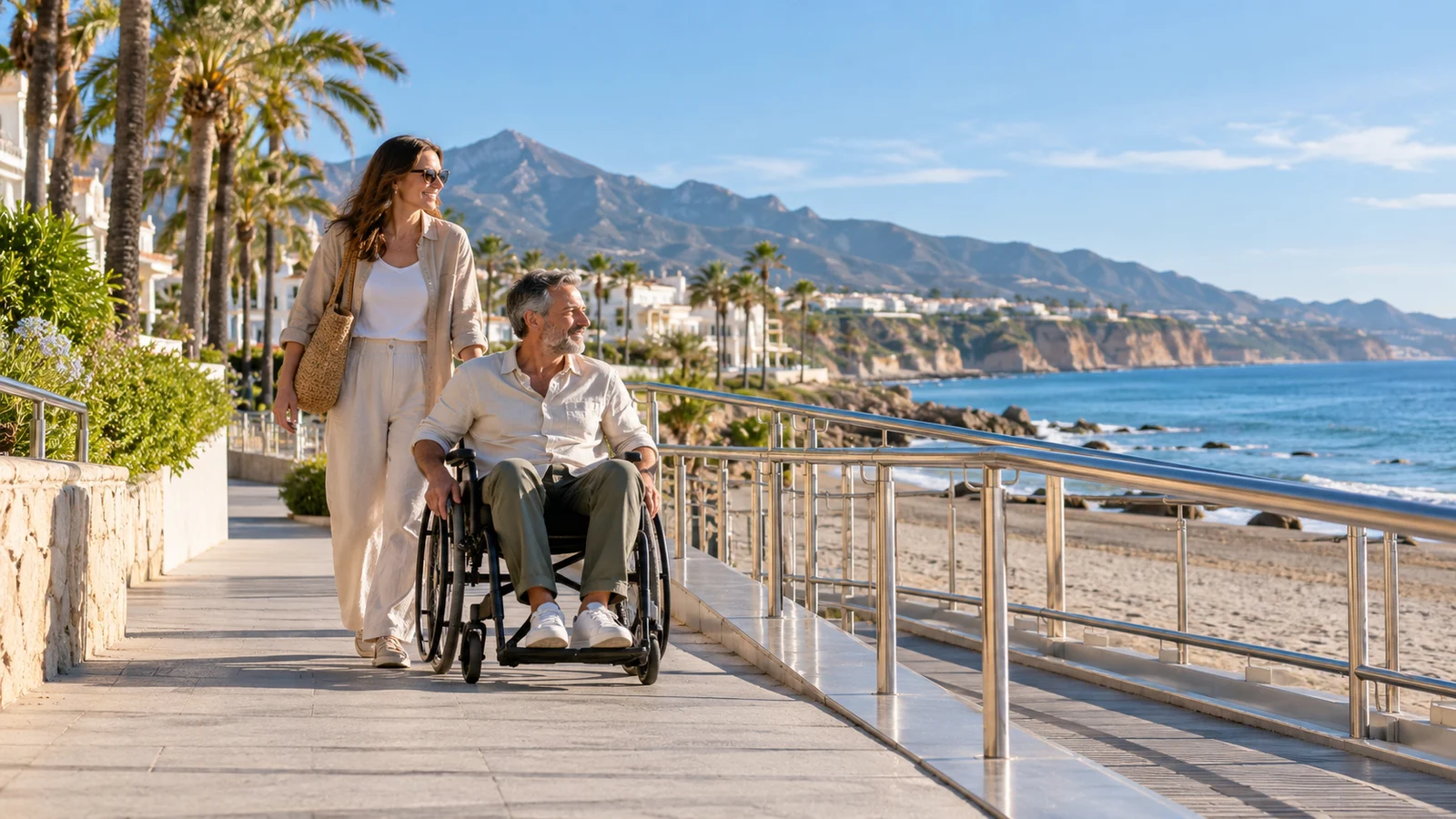
Accessible public transport on the Costa del Sol is possible, but the experience depends on the exact station, vehicle, stop and final route.
The strongest accessible public-transport corridor is Málaga–Torremolinos–Benalmádena–Fuengirola because it combines Renfe Cercanías C1 with urban transport. Málaga city adds a Metro network designed around universal accessibility, while EMT Málaga states that its full urban bus fleet is equipped with ramps for people with reduced mobility.
The main planning rule is simple: do not check only whether the vehicle is accessible. Check the complete chain from hotel door to platform, vehicle, destination stop and final pavement.
Quick answer
For many travellers with reduced mobility:
- Málaga city offers the strongest mix of accessible Metro, urban bus and rail.
- Torremolinos, Benalmádena and Fuengirola benefit from C1 rail, but individual stations and surrounding gradients differ.
- Marbella and Estepona rely more on intercity and local buses because there is no Cercanías line.
- Nerja also depends more heavily on buses and transfers.
Always confirm current accessibility for the exact journey before travelling.
Renfe Cercanías C1
C1 is the most important rail line for visitors because it connects Málaga, Málaga Airport, Torremolinos, Benalmádena and Fuengirola.
Renfe continues to invest in accessibility across the Málaga network.
In July 2026, Renfe began works to improve accessibility and lighting at Torreblanca and Montemar Alto and announced improvements at five Málaga Cercanías stations, including Málaga Centro Alameda, Victoria Kent and Plaza Mayor.
This is important because station accessibility is not static. Works and temporary routes can affect the journey.
Check the exact station
Do not assume every C1 station has identical access.
Before travelling, verify:
- lift or ramp availability;
- platform access;
- temporary works;
- assistance needs;
- accessible ticketing;
- route from street to platform.
A station can technically be accessible while the pavement outside remains steep or difficult.
This matters particularly in hillier parts of Torremolinos and Benalmádena.
Málaga Airport by train
C1 provides direct rail between Málaga Airport and Málaga city, Torremolinos, Benalmádena and Fuengirola.
For travellers with mobility needs, this can remove the need for a private airport transfer.
But check your final hotel route.
A direct train is not automatically the easiest choice if the station is uphill from your accommodation or the route includes difficult pavements.
Metro de Málaga
Metro de Málaga provides one of the clearest accessibility systems in the region.
Its 2025 service charter states that accessibility is managed under UNE 170001-2:2007 and that stations and trains are designed to remove architectural barriers.
The Metro also states that customer-facing facilities are accessible, including:
- lifts;
- ticket machines;
- gates;
- intercoms;
- tactile guidance;
- platform-to-train access suitable for wheelchairs and pushchairs.
This makes the Metro particularly useful for city-based visitors.
Visual and hearing accessibility on the Metro
Accessibility is not limited to wheelchairs.
Metro de Málaga reports:
- visual information;
- audible information;
- tactile routes;
- adapted ticketing;
- accessible intercoms.
Its sustainability report also highlights visual screens and audio announcements for passengers with sensory disabilities.
Travellers with specific sensory requirements should still check the current station and service information before travel.
EMT Málaga urban buses
EMT Málaga states that 100% of its fleet is equipped with ramps for people with reduced mobility.
Its sustainability information also describes:
- kneeling systems on buses;
- step-free routes from the central door to reserved spaces;
- optical and audible information;
- Braille stop buttons;
- visual and acoustic stop requests.
This makes Málaga city one of the strongest bus environments on the Costa del Sol.
Visual-accessibility support on EMT
EMT Málaga also provides an accessibility function for blind or visually impaired users.
The system can allow a registered user to request that a bus stop for pickup without needing to visually identify the approaching line.
The operator also describes audio information and high-visibility displays at stops.
This can be extremely useful for independent travel.
Intercity buses
Intercity travel is more variable than Metro or Málaga urban bus.
Some operators and routes explicitly identify PMR-accessible services, but accessibility can depend on:
- vehicle;
- timetable;
- luggage compartment;
- wheelchair type;
- advance booking;
- stop design.
For example, Avanza currently marks some Málaga–Estepona services as PMR bus services.
Do not assume every departure uses the same accessible vehicle.
Confirm the exact service.
Marbella and Estepona
Because Marbella and Estepona have no Cercanías station, buses and transfers are more important.
For wheelchair users, contact the operator before travel and ask:
- whether the specific departure accepts a wheelchair;
- whether boarding is by lift/ramp;
- whether transfer from chair is required;
- whether powered chairs are accepted;
- battery restrictions;
- advance notice;
- accessible stop at destination.
A coach may be accessible while the stop environment is not.
Nerja
Nerja also relies more heavily on bus and road transport.
If mobility is limited, compare intercity bus with a prebooked adapted transfer.
The deciding factor may be the final route from Nerja bus stop to accommodation, especially because parts of the town are hilly.
Málaga Bus Station
Málaga Bus Station publishes several accessibility features, including:
- adapted information counters and ticket offices;
- tactile guidance;
- Braille platform numbering;
- high-visibility information;
- digital public-address systems;
- accessible toilet.
That makes the station a stronger interchange point for travellers with visual or mobility needs.
Still check the accessibility of the specific coach.
Taxi and adapted taxi
Taxi can be useful for the “last kilometre”.
This is especially relevant when:
- the station is accessible but the hotel is uphill;
- the bus stop is too far;
- luggage makes independent movement difficult;
- the traveller uses a wheelchair.
If a wheelchair-accessible taxi is essential, prebook rather than relying on immediate street availability.
Private adapted transfer
A private adapted transfer can be the best choice for:
- powered wheelchair users;
- large mobility scooters;
- airport arrivals;
- families with several bags;
- late-night arrivals;
- destinations without rail.
Confirm the vehicle configuration in writing.
Ask whether you remain seated in the wheelchair or transfer to a vehicle seat.
Mobility scooters
Mobility scooters can be more complicated than manual wheelchairs because of size and battery type.
Before using public transport, check:
- dimensions;
- weight;
- battery;
- lift capacity;
- allowed position;
- turning space.
Do not assume that a service accepting manual wheelchairs automatically accepts every scooter.
Travelling with a walker
For a walker or rollator, the key issues are often:
- step-free boarding;
- lift availability;
- room to store or hold the device;
- station seating;
- distance between connections.
Metro and urban bus may be straightforward, but long interchanges can still be tiring.
Travelling with visual impairment
Useful features may include:
- tactile paving;
- audio announcements;
- Braille;
- high-contrast signage;
- app-based stop support.
Metro de Málaga and EMT Málaga provide several of these systems.
For an unfamiliar route, plan the interchange points in advance.
Travelling with hearing impairment
Look for:
- visual platform information;
- screens inside vehicles;
- written disruption information;
- visual stop indicators.
When assistance is essential, save the operator's customer-service contact before travel.
Temporary lifts and works
This is one of the biggest risks in accessible travel.
A journey that is normally step-free can become difficult if:
- a lift fails;
- an entrance closes;
- a platform route changes;
- construction blocks the pavement.
Renfe’s 2026 station works show why checking current service information matters.
Always review disruptions shortly before departure.
The final 500 metres
The final route often matters more than the train.
Check:
- slope;
- kerbs;
- pavement;
- crossings;
- steps;
- lighting;
- hotel entrance.
This is particularly important in Torremolinos, Benalmádena and Nerja.
A taxi for the last section can make an otherwise accessible journey practical.
Airport strategy
If staying on C1, train may be easiest.
If staying in Marbella, Estepona, Mijas inland or Nerja, compare:
- coach;
- adapted taxi;
- private transfer.
Do not choose purely by price.
A slightly more expensive transfer may remove multiple transfers and reduce risk.
Plan B
For essential journeys, have a backup.
Save:
- taxi number;
- operator customer service;
- hotel reception;
- alternative stop;
- private transfer contact.
Accessibility problems are much easier to manage when you already know the fallback.
Before travelling
Confirm:
- exact station/stop;
- lift/ramp status;
- accessible vehicle;
- advance-booking requirements;
- wheelchair/scooter rules;
- assistance;
- final pavement;
- taxi backup;
- current disruptions;
- return journey.
Sources
- Metro de Málaga — 2025 Service Charter and universal-accessibility information.
- EMT Málaga — accessibility systems and 100% ramp-equipped fleet.
- Renfe — 2026 accessibility works at Málaga Cercanías stations.
- Estación de Autobuses de Málaga — accessible counters, tactile guidance, Braille and PMR facilities.
- Avanza — current PMR-marked intercity services on Málaga–Estepona routes.
Accessibility and vehicle assignments can change. Confirm the exact service before travel.
Continue your Costa del Sol planning
Other published guides for the same destination or a closely related topic.