Parking on the Costa del Sol: practical rules for beaches, old towns and busy resorts
Parking on the Costa del Sol is not difficult everywhere, but it becomes a real trip-planning issue in historic centres, beachfront areas and peak-season resorts. The safest strategy is not to hunt endlessly for a free space. It is to understand where regulated parking applies, when a paid garage is the better choice and whether your hotel can solve the problem before you arrive. ## Quick answer Expect the most parking pressure in: - central Málaga; - Marbella Old Town and central seafront; - Puerto Banús; - central Fuengirola; - Torremolinos beach zones; - Benalmádena Costa / Puerto Marina; - central Estepona; - Nerja centre; - popular beaches in July and August. If you are staying several nights, hotel parking can be worth more than a cheaper room without it. ## Málaga: understand SARE and ZBE Málaga operates SARE, its regulated on-street parking system. The municipal mobility department describes SARE as time-limited regulated parking intended to encourage turnover and balance demand. Do not assume every blue-space rule is the same as another town. Check: - sector; - maximum stay; - payment method; - signs; - resident restrictions. Málaga also has a Low Emission Zone framework, so parking and driving access are separate questions. A garage can solve parking but not necessarily vehicle-access restrictions. ## Central Málaga For a day in the Historic Centre, a public garage is often simpler than circulating repeatedly looking for street parking. This is especially true if you: - arrive at midday; - have luggage; - travel with children; - need predictable timing; - have a restaurant or museum booking. Street parking can be cheaper, but wasted driving time has a cost too. ## Marbella: blue and green regulated zones Marbella Tourism currently publishes official blue/green parking information. Its current page states that regulated hours do not depend on season and lists weekday and Saturday operating periods, with Sundays and public holidays free. The exact maximum stay depends on zone, so always read the meter/sign before leaving the car. Marbella is too large for one parking strategy. ## Marbella Old Town For the Old Town, avoid trying to drive into every narrow central street. Use a nearby garage or legal regulated space and walk. This reduces: - navigation stress; - one-way mistakes; - repeated circling; - pedestrian conflicts. If your hotel is in the Old Town, ask for arrival instructions before driving there. ## Puerto Banús Puerto Banús can become heavily pressured at: - dinner time; - weekends; - summer; - events. If you have a reservation, allow parking time. A paid garage can be much better than arriving late while searching for free street parking. If you plan nightlife, taxi may be easier than driving. ## Fuengirola: blue and seasonal green zones Fuengirola’s sustainable mobility plan documents a regulated-parking system with blue and green areas. The plan describes: - blue zones operating year-round in central streets; - green zones associated with seafront areas and seasonal regulation. Because local parking rules can be updated, read current street signs rather than relying on an old screenshot. Fuengirola also has excellent C1 rail, so many visitors do not need a car every day. ## Fuengirola beach parking In summer, parking near the seafront can fill early. If your plan is a full beach day: - arrive earlier; - use a garage; - stay near the beach and walk; - or use train/bus. Driving from hotel to beach every morning can create more stress than value. ## Benalmádena Benalmádena has three different parking realities. **Arroyo de la Miel:** urban streets, shops and station pressure. **Benalmádena Costa:** beach and hotel parking pressure. **Benalmádena Pueblo:** narrower streets and village geometry. Do not choose accommodation only by municipality name. Ask whether the specific area has private parking or realistic street options. ## Puerto Marina Around Puerto Marina, evening and summer demand can be high. If you are going for dinner or nightlife, consider: - walking; - taxi; - bus; - paid parking. A free space several streets away may not be a meaningful saving if you spend 25 minutes looking for it. ## Torremolinos Torremolinos parking pressure varies sharply by area. Centro, La Carihuela, Bajondillo and Playamar create different conditions. La Carihuela and Bajondillo can be particularly busy during beach hours and dinner. For a hotel stay, check whether parking is: - onsite; - nearby; - paid; - reservable; - suitable for a large car. ## Estepona: unusually strong municipal low-cost parking Estepona has developed a notable municipal parking network. In August 2025, the Town Hall announced that La Viña became the fifth municipal car park operating under the low-cost model, bringing the network to around 2,300 spaces. The municipality stated a daytime price of €1 and €2 at night for those facilities at that time. Because tariffs can change, verify current conditions. ## El Carmen in Estepona Be careful with current status. Municipal updates in June and July 2026 described El Carmen as nearing completion and expected to open during summer, with more than 300 spaces. Until a later official source confirms operation, do not assume it is open. Use the already operating municipal network instead. ## Nerja Nerja centre is compact and can be congested. Historic streets and beach routes can make circulation slower than expected. If you stay centrally, parking once and walking can be much better than using the car for every movement. For Burriana, check the hill and return route before deciding whether driving is worthwhile. ## Beach parking in summer At popular beaches, the main variable is time. A space that is easy at 09:00 may be nearly impossible at 12:30. For peak beach days: - arrive early; - use official parking; - do not block access; - do not park on protected land; - respect disabled bays and loading zones. A fine or tow will cost far more than a garage. ## Old towns Historic centres are poor places to improvise. Expect: - narrow streets; - one-way systems; - pedestrianisation; - restricted access; - limited loading time. Before driving to a hotel in an old town, ask for exact vehicle-arrival instructions. ## Hotel parking For a road trip, hotel parking can be one of the most valuable amenities. Ask: - is it onsite?; - can it be reserved?; - nightly cost?; - height limit?; - EV charging?; - in/out privileges?; - large-car suitability?; - accessible spaces? “Parking available” can mean a public garage several streets away. ## Rental cars Before accepting a large rental car, consider where you will park. A compact car can make: - old-town garages; - narrow ramps; - street spaces; - hotel car parks much easier. Do not rent a larger vehicle than your trip requires. ## Accessible parking If you use an official disabled-parking permit, verify local recognition and signage. Never assume every blue-marked area is a disabled bay or that every disabled bay follows identical rules. For hotels, reserve an accessible space if possible. Check the route from the bay to the entrance. ## EV charging Do not choose a hotel only because it says “EV charging”. Confirm: - connector; - power; - number of chargers; - whether reservation is possible; - whether parking fees apply; - whether charging is guest-only. Public charger availability can change. ## Parking apps Different municipalities and operators may use different payment systems. Follow the sign at the exact space. Do not download an app simply because you used it in another Costa del Sol town. The official sign is the reference. ## Sundays and public holidays Rules vary. Marbella’s current official information states Sundays and public holidays are free in its blue/green regulated zones. Do not generalise that rule to every municipality. Check the exact local signage. ## Fines and towing Never treat a parking fine as a normal trip cost. Avoid: - bus stops; - loading zones; - disabled bays without permit; - yellow markings; - garage entrances; - pedestrian access; - emergency access. If signs conflict with an old online guide, follow the current sign. ## Parking versus taxi For dinner or nightlife, taxi may be the better parking strategy. This is particularly true when: - alcohol is involved; - you are visiting Puerto Banús; - the restaurant is in a historic centre; - parking demand is high. Driving only makes sense if it reduces friction. ## Parking versus public transport For Málaga, Torremolinos, Benalmádena and Fuengirola, C1 can remove the need to park completely. If your day trip is mainly around a station-served centre, train may be easier than driving. For Marbella, Estepona and Nerja, parking decisions matter more because rail is absent. ## Long stays For a two-week stay, calculate parking before booking. A low nightly hotel rate plus €20–30 daily parking can materially change the real cost. Compare: - hotel with parking; - apartment with private bay; - no-car base; - rental car for only selected days. You may not need a car for the whole trip. ## Best parking strategy by destination **Málaga:** garage or SARE; check ZBE separately. **Fuengirola:** use C1 when possible; regulated zones in central/seafront areas. **Marbella:** choose parking based on district; garage for Old Town/Puerto Banús visits. **Estepona:** check municipal low-cost parking network. **Benalmádena/Torremolinos:** hotel parking can be especially valuable in beach zones. **Nerja:** central parking + walking is often easier than repeated driving. ## Before driving Check: 1. exact destination; 2. regulated-zone signs; 3. hotel parking; 4. garage height; 5. ZBE/access rules; 6. beach arrival time; 7. disabled/EV needs; 8. expected evening demand; 9. whether public transport is easier; 10. a backup garage. The best parking plan is the one that prevents you spending your holiday circling blocks. ## Sources - Ayuntamiento de Málaga / Área de Movilidad — SARE. - Turismo Marbella — current blue and green regulated parking information. - Ayuntamiento de Fuengirola — Sustainable Urban Mobility Plan and regulated parking. - Ayuntamiento de Estepona — operating municipal low-cost parking network. - Ayuntamiento de Estepona — 2026 El Carmen construction-status updates. Parking rules, tariffs and opening status can change. Check official local information and signs before parking.
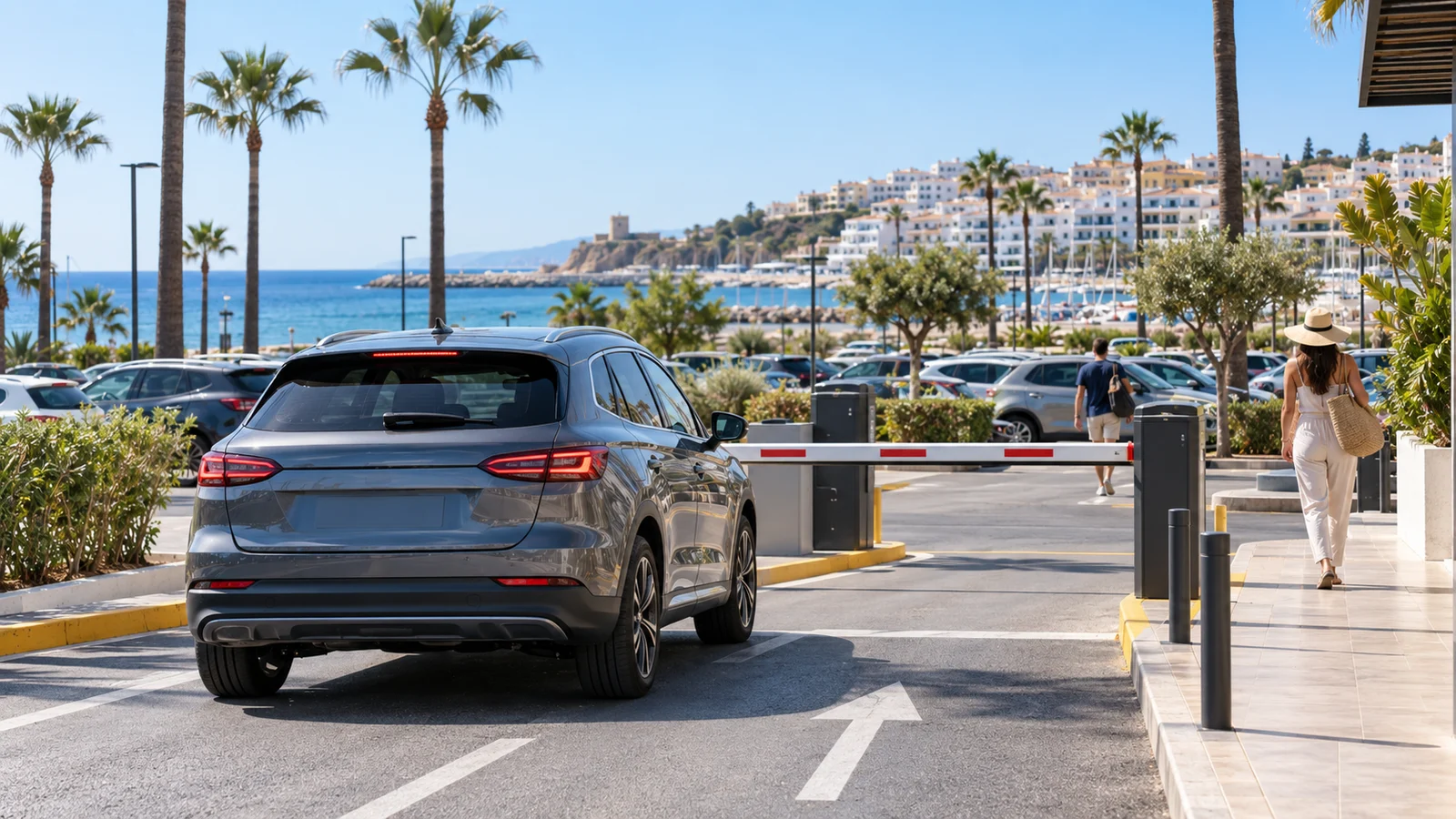
Parking on the Costa del Sol is not difficult everywhere, but it becomes a real trip-planning issue in historic centres, beachfront areas and peak-season resorts.
The safest strategy is not to hunt endlessly for a free space. It is to understand where regulated parking applies, when a paid garage is the better choice and whether your hotel can solve the problem before you arrive.
Quick answer
Expect the most parking pressure in:
- central Málaga;
- Marbella Old Town and central seafront;
- Puerto Banús;
- central Fuengirola;
- Torremolinos beach zones;
- Benalmádena Costa / Puerto Marina;
- central Estepona;
- Nerja centre;
- popular beaches in July and August.
If you are staying several nights, hotel parking can be worth more than a cheaper room without it.
Málaga: understand SARE and ZBE
Málaga operates SARE, its regulated on-street parking system.
The municipal mobility department describes SARE as time-limited regulated parking intended to encourage turnover and balance demand.
Do not assume every blue-space rule is the same as another town.
Check:
- sector;
- maximum stay;
- payment method;
- signs;
- resident restrictions.
Málaga also has a Low Emission Zone framework, so parking and driving access are separate questions.
A garage can solve parking but not necessarily vehicle-access restrictions.
Central Málaga
For a day in the Historic Centre, a public garage is often simpler than circulating repeatedly looking for street parking.
This is especially true if you:
- arrive at midday;
- have luggage;
- travel with children;
- need predictable timing;
- have a restaurant or museum booking.
Street parking can be cheaper, but wasted driving time has a cost too.
Marbella: blue and green regulated zones
Marbella Tourism currently publishes official blue/green parking information.
Its current page states that regulated hours do not depend on season and lists weekday and Saturday operating periods, with Sundays and public holidays free.
The exact maximum stay depends on zone, so always read the meter/sign before leaving the car.
Marbella is too large for one parking strategy.
Marbella Old Town
For the Old Town, avoid trying to drive into every narrow central street.
Use a nearby garage or legal regulated space and walk.
This reduces:
- navigation stress;
- one-way mistakes;
- repeated circling;
- pedestrian conflicts.
If your hotel is in the Old Town, ask for arrival instructions before driving there.
Puerto Banús
Puerto Banús can become heavily pressured at:
- dinner time;
- weekends;
- summer;
- events.
If you have a reservation, allow parking time.
A paid garage can be much better than arriving late while searching for free street parking.
If you plan nightlife, taxi may be easier than driving.
Fuengirola: blue and seasonal green zones
Fuengirola’s sustainable mobility plan documents a regulated-parking system with blue and green areas.
The plan describes:
- blue zones operating year-round in central streets;
- green zones associated with seafront areas and seasonal regulation.
Because local parking rules can be updated, read current street signs rather than relying on an old screenshot.
Fuengirola also has excellent C1 rail, so many visitors do not need a car every day.
Fuengirola beach parking
In summer, parking near the seafront can fill early.
If your plan is a full beach day:
- arrive earlier;
- use a garage;
- stay near the beach and walk;
- or use train/bus.
Driving from hotel to beach every morning can create more stress than value.
Benalmádena
Benalmádena has three different parking realities.
Arroyo de la Miel: urban streets, shops and station pressure.
Benalmádena Costa: beach and hotel parking pressure.
Benalmádena Pueblo: narrower streets and village geometry.
Do not choose accommodation only by municipality name.
Ask whether the specific area has private parking or realistic street options.
Puerto Marina
Around Puerto Marina, evening and summer demand can be high.
If you are going for dinner or nightlife, consider:
- walking;
- taxi;
- bus;
- paid parking.
A free space several streets away may not be a meaningful saving if you spend 25 minutes looking for it.
Torremolinos
Torremolinos parking pressure varies sharply by area.
Centro, La Carihuela, Bajondillo and Playamar create different conditions.
La Carihuela and Bajondillo can be particularly busy during beach hours and dinner.
For a hotel stay, check whether parking is:
- onsite;
- nearby;
- paid;
- reservable;
- suitable for a large car.
Estepona: unusually strong municipal low-cost parking
Estepona has developed a notable municipal parking network.
In August 2025, the Town Hall announced that La Viña became the fifth municipal car park operating under the low-cost model, bringing the network to around 2,300 spaces.
The municipality stated a daytime price of €1 and €2 at night for those facilities at that time.
Because tariffs can change, verify current conditions.
El Carmen in Estepona
Be careful with current status.
Municipal updates in June and July 2026 described El Carmen as nearing completion and expected to open during summer, with more than 300 spaces.
Until a later official source confirms operation, do not assume it is open.
Use the already operating municipal network instead.
Nerja
Nerja centre is compact and can be congested.
Historic streets and beach routes can make circulation slower than expected.
If you stay centrally, parking once and walking can be much better than using the car for every movement.
For Burriana, check the hill and return route before deciding whether driving is worthwhile.
Beach parking in summer
At popular beaches, the main variable is time.
A space that is easy at 09:00 may be nearly impossible at 12:30.
For peak beach days:
- arrive early;
- use official parking;
- do not block access;
- do not park on protected land;
- respect disabled bays and loading zones.
A fine or tow will cost far more than a garage.
Old towns
Historic centres are poor places to improvise.
Expect:
- narrow streets;
- one-way systems;
- pedestrianisation;
- restricted access;
- limited loading time.
Before driving to a hotel in an old town, ask for exact vehicle-arrival instructions.
Hotel parking
For a road trip, hotel parking can be one of the most valuable amenities.
Ask:
- is it onsite?;
- can it be reserved?;
- nightly cost?;
- height limit?;
- EV charging?;
- in/out privileges?;
- large-car suitability?;
- accessible spaces?
“Parking available” can mean a public garage several streets away.
Rental cars
Before accepting a large rental car, consider where you will park.
A compact car can make:
- old-town garages;
- narrow ramps;
- street spaces;
- hotel car parks
much easier.
Do not rent a larger vehicle than your trip requires.
Accessible parking
If you use an official disabled-parking permit, verify local recognition and signage.
Never assume every blue-marked area is a disabled bay or that every disabled bay follows identical rules.
For hotels, reserve an accessible space if possible.
Check the route from the bay to the entrance.
EV charging
Do not choose a hotel only because it says “EV charging”.
Confirm:
- connector;
- power;
- number of chargers;
- whether reservation is possible;
- whether parking fees apply;
- whether charging is guest-only.
Public charger availability can change.
Parking apps
Different municipalities and operators may use different payment systems.
Follow the sign at the exact space.
Do not download an app simply because you used it in another Costa del Sol town.
The official sign is the reference.
Sundays and public holidays
Rules vary.
Marbella’s current official information states Sundays and public holidays are free in its blue/green regulated zones.
Do not generalise that rule to every municipality.
Check the exact local signage.
Fines and towing
Never treat a parking fine as a normal trip cost.
Avoid:
- bus stops;
- loading zones;
- disabled bays without permit;
- yellow markings;
- garage entrances;
- pedestrian access;
- emergency access.
If signs conflict with an old online guide, follow the current sign.
Parking versus taxi
For dinner or nightlife, taxi may be the better parking strategy.
This is particularly true when:
- alcohol is involved;
- you are visiting Puerto Banús;
- the restaurant is in a historic centre;
- parking demand is high.
Driving only makes sense if it reduces friction.
Parking versus public transport
For Málaga, Torremolinos, Benalmádena and Fuengirola, C1 can remove the need to park completely.
If your day trip is mainly around a station-served centre, train may be easier than driving.
For Marbella, Estepona and Nerja, parking decisions matter more because rail is absent.
Long stays
For a two-week stay, calculate parking before booking.
A low nightly hotel rate plus €20–30 daily parking can materially change the real cost.
Compare:
- hotel with parking;
- apartment with private bay;
- no-car base;
- rental car for only selected days.
You may not need a car for the whole trip.
Best parking strategy by destination
Málaga: garage or SARE; check ZBE separately.
Fuengirola: use C1 when possible; regulated zones in central/seafront areas.
Marbella: choose parking based on district; garage for Old Town/Puerto Banús visits.
Estepona: check municipal low-cost parking network.
Benalmádena/Torremolinos: hotel parking can be especially valuable in beach zones.
Nerja: central parking + walking is often easier than repeated driving.
Before driving
Check:
- exact destination;
- regulated-zone signs;
- hotel parking;
- garage height;
- ZBE/access rules;
- beach arrival time;
- disabled/EV needs;
- expected evening demand;
- whether public transport is easier;
- a backup garage.
The best parking plan is the one that prevents you spending your holiday circling blocks.
Sources
- Ayuntamiento de Málaga / Área de Movilidad — SARE.
- Turismo Marbella — current blue and green regulated parking information.
- Ayuntamiento de Fuengirola — Sustainable Urban Mobility Plan and regulated parking.
- Ayuntamiento de Estepona — operating municipal low-cost parking network.
- Ayuntamiento de Estepona — 2026 El Carmen construction-status updates.
Parking rules, tariffs and opening status can change. Check official local information and signs before parking.
Continue your Costa del Sol planning
Other published guides for the same destination or a closely related topic.