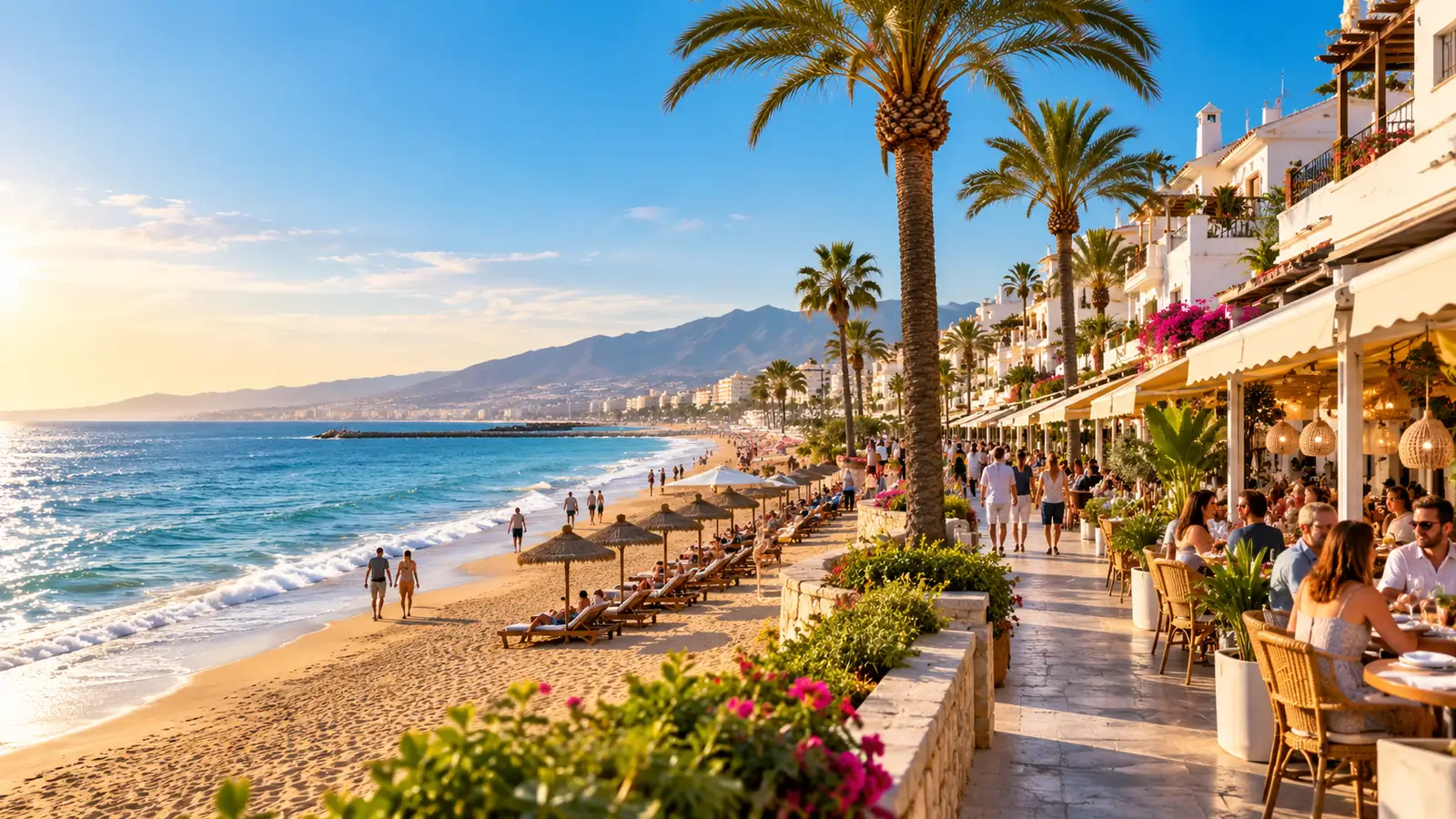
A day in Marbella: from the Old Town to the promenade
Follow a coherent central route from Plaza de los Naranjos through Marbella’s historic streets, then down via Alameda and Avenida del Mar to the sea.
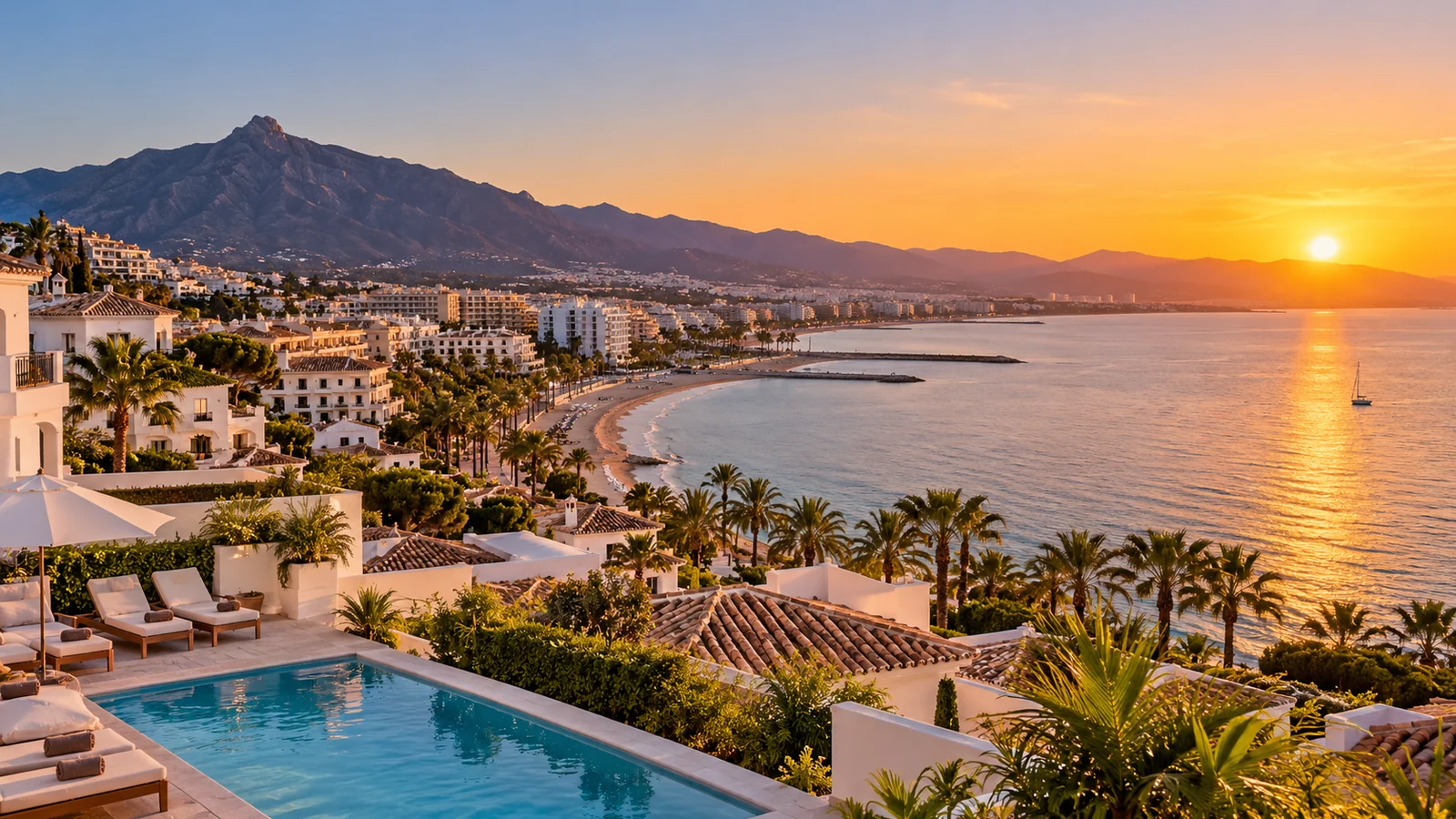
Start in Plaza de los Naranjos
Begin in Plaza de los Naranjos, the most useful starting point for a first day in central Marbella. It sits at the heart of the Old Town and brings several historic buildings together, so you can orientate yourself before choosing how much time to spend inside any one of them.
Look first at the Town Hall, which stands on the north side of the square. The original building was completed in 1572 and was later enlarged, including with an 18th-century extension. The square was also associated with the Casa del Corregidor, the Ermita de Santiago and other buildings connected with Marbella’s development after the Christian conquest.
This is a good place to begin slowly rather than treating the Old Town as a checklist. From here, the route continues through a compact network of streets, with the main sights close enough to form one walking district. The official town map identifies the square, Town Hall, Calle Ancha, the church, castle remains and museum within this central area.
The church, castle and old walls
From Plaza de los Naranjos, continue towards Plaza de la Iglesia and the Church of Nuestra Señora de la Encarnación. The municipality describes the church as probably having been built over Marbella’s principal mosque, with later construction and remodelling taking place from the 16th century onwards. Its position makes it a natural next stop, but do not assume that every historic building on the route has regular visitor entry. The supplied information establishes the locations and heritage importance, not universal interior opening arrangements.
The next part of the walk is particularly effective because the remains of Marbella’s castle and walls are not isolated at an out-of-town archaeological site. They are embedded in the present-day street network around Plaza de la Iglesia, Calle Carmen, Calle Portada, Calle Salinas and nearby streets. The municipality identifies the castle as the most important surviving vestige of Muslim civilisation in central Marbella, with surviving walls dating principally from the 11th and 12th centuries.
Take this section as an urban history walk: a church square, fragments of the Islamic-era fortifications and ordinary streets occupied by present-day Marbella. It is a better sequence than trying to separate each monument into a different excursion.
Choose the museum or more Old Town time
The main timing decision is the Museo del Grabado Español Contemporáneo, on Calle Hospital Bazán. It occupies the former Hospital Bazán, a 16th-century Renaissance civil building in the Old Town, and offers the route’s clearest indoor cultural stop.
Include it if you would like a planned museum visit alongside the architectural sights. Leave it out if the opening window does not fit your day; the route still works without it. The museum’s published information lists a €5 admission price and a pattern of morning opening from Monday to Friday and at weekends, with additional afternoon opening from Wednesday to Friday. These are planning details rather than guarantees: check the museum’s current hours, admission information and exhibition programme close to your visit.
The published programme also lists Salvador Dalí, diez recetas de inmortalidad from 28 May to 15 November 2026. As with any temporary exhibition, confirm that it is still running before making it the reason for your visit.
If you skip the museum, use the extra time for the surrounding lanes rather than adding a distant attraction. The strength of this morning is its concentration: Plaza de los Naranjos, the church, castle and wall remains, and Calle Hospital Bazán all belong to the same Old Town story.
Descend through Alameda and Avenida del Mar
When you are ready to leave the historic centre, follow the natural descent through Parque de la Alameda and then Avenida del Mar. Alameda is an 18th-century green space and a useful transition between the Old Town and the lower part of the city. It is also a sensible place to pause, especially if you want shade or a slower break before continuing towards the coast.
From Alameda, Avenida del Mar links directly with the Paseo Marítimo. This is not just a connecting road: the avenue has fountains, pergolas, planted areas and a collection of 10 bronze sculptures designed by Salvador Dalí. It gives the day a clear change of mood, moving from enclosed historic streets to an open public-art setting before the sea.
Treat Parque de la Constitución as optional. It can work as an additional green pause before or after the promenade, but it is not necessary to complete the Old Town-to-sea route. Keeping it optional makes the day easier to adapt if you have spent longer in the museum or Old Town.
Finish at the seafront — and decide about Puerto Banús
The central Paseo Marítimo is the natural finish for this route. You have moved from the square that organised the Old Town, through religious and Islamic-era remains, past a museum option, and down through public gardens and sculpture to the sea. There is no need to force another destination into the same walking narrative.
That matters when deciding about Puerto Banús. The municipal map treats it as a separate destination in Nueva Andalucía, not as a natural continuation of the central Old Town walk. It is linked with central Marbella by the urban bus network, but adding it changes the geography and emphasis of the day. Choose it only if you specifically want a separate marina excursion and are happy to organise another leg of the day around transport.
For a one-day visit, the simplest plan is therefore: Old Town in the morning, museum or extra lanes according to opening hours and interest, a break around Alameda or the lower centre, then Avenida del Mar and the promenade. Check changeable details close to travel, and remember that the Old Town streets should not be assumed to be fully step-free; the supplied sources do not provide a complete accessibility audit.
Continue your Costa del Sol planning
Other published guides for the same destination or a closely related topic.