East or west Costa del Sol? How the two sides differ
There is no universally better side of the Costa del Sol.
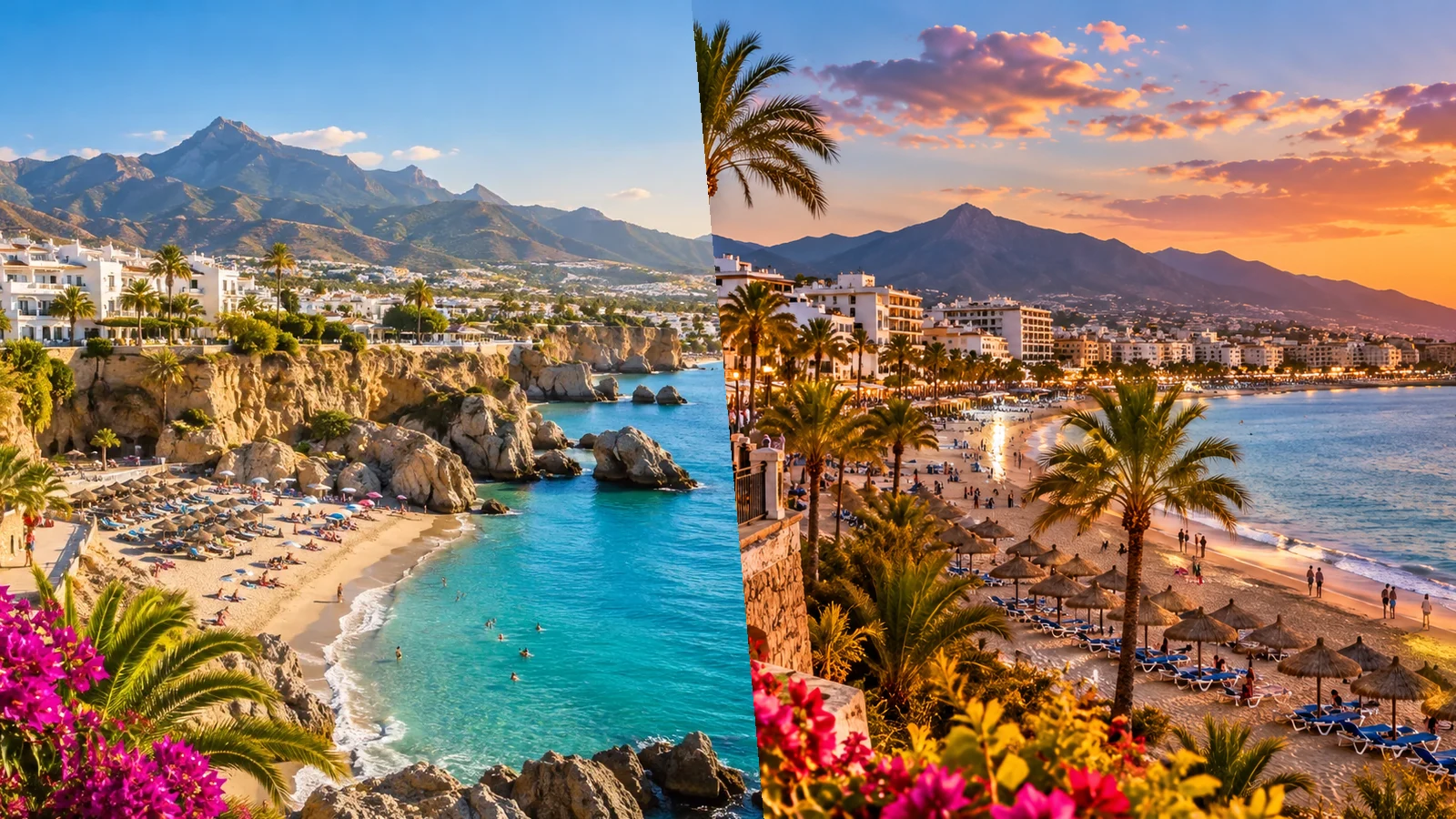
East or west Costa del Sol? How the two sides differ
There is no universally better side of the Costa del Sol.
The eastern and western coasts suit different travel styles because their landscapes, transport structure, urban form and nearby day-trip options differ.
A useful comparison should therefore help you choose a base, not crown a winner.
The western Costa del Sol is more urban and transport-heavy
The western side includes places such as Torremolinos, Benalmádena, Fuengirola, Marbella and Estepona.
Much of this corridor has dense tourism infrastructure, larger urban areas, marinas, golf, established resort zones and a broad hospitality economy.
Between Málaga and Fuengirola, the C1 rail corridor adds an important advantage for visitors who want to avoid driving.
Further west, especially beyond Fuengirola, buses and road transport become more important again.
The eastern Costa del Sol feels more connected to the Axarquía
East of Málaga, the coast transitions toward Rincón de la Victoria, Torre del Mar, Torrox, Nerja and the landscapes of the Axarquía.
The relationship between coast and inland is especially visible here.
Steep hills, white villages, vineyards and agricultural landscapes sit relatively close to coastal settlements.
For travellers who want to combine beaches with inland scenery and village culture, that geography can be a major part of the appeal.
Transport is one of the biggest practical differences
The western corridor between Málaga and Fuengirola benefits from the commuter train.
The eastern coast does not have an equivalent rail spine.
That means a car-free trip is often easier to improvise in Torremolinos, Benalmádena or Fuengirola than in Nerja or many eastern destinations.
This does not make the east inaccessible.
It simply means buses, taxis or private transport matter more.
The west offers more large-scale resort infrastructure
Western Costa del Sol destinations include some of the region's largest hotel zones, golf clusters, marinas and large leisure attractions.
That scale can be useful for travellers who want many services concentrated nearby.
It can also mean a more urban or resort-oriented atmosphere in some areas.
The exact feel still varies enormously from town to town.
The east has a stronger visible landscape contrast
The Axarquía creates a sharper visual transition between coast and steep inland terrain.
Villages, vineyards, paseros, ridgelines and agricultural slopes are easier to integrate into the same trip.
That makes the east especially attractive for visitors who want coastal time without separating it completely from inland rural landscapes.
Neither side is uniformly quiet, cheap or traditional
This is where simplistic comparisons fail.
Both east and west contain busy beaches and quieter corners.
Both have historic centres and modern development.
Both have expensive and lower-cost accommodation depending on area and season.
Statements such as "the east is always cheaper" or "the west is always more crowded" require current evidence and should not be treated as permanent truths.
Choose by trip style
The west may suit you better if you prioritise:
- rail access between several coastal towns;
- larger resort infrastructure;
- golf and marinas;
- a wider concentration of major attractions;
- frequent movement between urban coastal centres.
The east may suit you better if you prioritise:
- a stronger coast-to-village landscape contrast;
- Axarquía scenery;
- trips combining beach with inland agriculture and white villages;
- a smaller-town base in places such as Nerja or Torrox.
These are tendencies, not scores.
A mixed trip can be better than choosing sides
There is no need to treat east and west as competing holidays.
A trip can use Málaga as a hinge, spend several nights west for urban convenience and then move east for a different landscape and rhythm.
That approach often reveals the real strength of the province: variety over relatively short distances.
Keep commercial and live data separate
Hotel prices, availability, traffic, crowd levels and temporary events change.
Costa Guest should keep those in live layers.
The evergreen comparison should stay focused on geography, transport and travel style.
Sources used for this draft
- Turismo Costa del Sol · provincial tourism material
- Turismo Costa del Sol · destination management material
- Diputación de Málaga · Senda Litoral