Dolphin watching on the Costa del Sol: where to go, what to expect and how to choose responsibly
Seeing dolphins at sea can be one of the most memorable experiences on the Costa del Sol, but it is important to plan it as wildlife observation rather than as a guaranteed attraction.
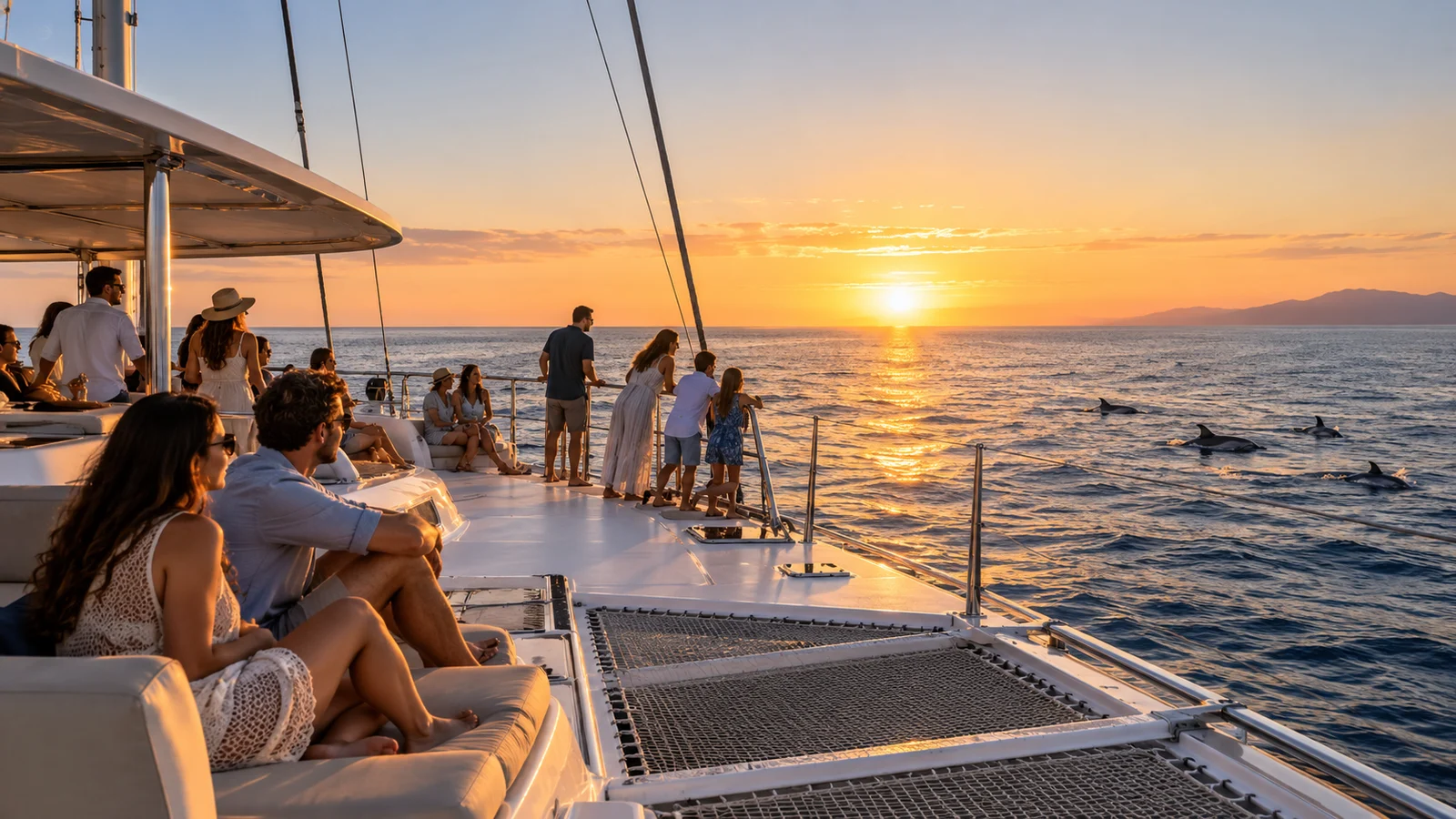
Wild dolphins choose where they travel. No responsible operator can promise that animals will appear on every departure, and the best trip is one that remains enjoyable as a boat experience even if the wildlife is distant or absent.
Spain also regulates recreational cetacean watching. The Ministry for the Ecological Transition and Demographic Challenge (MITECO) publishes the rules for approaching cetaceans and maintains a list of authorised operators.
The quick answer
For most visitors, the strongest departure areas are the established marinas where commercial sightseeing boats already operate, especially Benalmádena Puerto Marina and other Costa del Sol ports with regular excursion activity.
A good dolphin-watching trip should offer:
- a properly authorised operator when the activity is specifically sold as cetacean watching;
- realistic language rather than a guaranteed sighting;
- a clear departure port and duration;
- enough shade, seating and toilets for your group;
- cancellation or rescheduling rules for poor sea conditions;
- respectful behaviour around animals.
In March 2026, Marbella City Council's youth programme advertised a dolphin-watching activity departing from Puerto Marina in Benalmádena, confirming that the marina remains an active base for this type of trip.
Dolphins are wild animals
This is the most important point in the guide.
A dolphin-watching excursion is not comparable to visiting an aquarium or scheduled show. The animals are free-ranging and their movements depend on food, sea conditions, season and many other factors.
A responsible operator should explain that sightings are possible rather than certain.
Treat any absolute “100% guaranteed dolphins” claim carefully unless the provider clearly explains what the guarantee actually means, such as a free repeat trip rather than a biological promise.
Spanish rules protect cetaceans
MITECO states that recreational cetacean-watching activity is regulated under Royal Decree 1727/2007 and requires prior administrative authorisation.
The protection rules are designed to avoid chasing, blocking, feeding, touching or disturbing animals.
Among the behaviour prohibited in the protected mobile space are:
- physical contact with cetaceans;
- feeding them;
- blocking their movement or crossing through a group;
- separating animals, especially adults from calves;
- making loud sounds to attract or drive them away;
- swimming or diving in the exclusion zone.
MITECO also publishes an official search tool for authorised companies.
For a wildlife-focused trip, checking that authorisation is a much stronger quality signal than choosing only by star rating or social-media video.
How boats should behave around dolphins
The rules are not only about passengers.
MITECO's responsible-navigation guidance says vessels should approach smoothly, avoid abrupt course changes and travel parallel to the animals rather than cutting across their route.
The guidance also limits speed in the observation area and prohibits circling a group.
As a passenger, you do not control the helm, but you can still observe whether the crew treats wildlife calmly.
If a boat repeatedly chases animals, cuts in front of them or encourages passengers to enter the water close to cetaceans, that is a warning sign.
Where to depart from
Benalmádena Puerto Marina is one of the clearest visitor bases for dolphin-watching excursions on this part of the coast.
The municipality and local public programmes continue to reference commercial boat trips from the marina, and the harbour is easy to combine with restaurants, waterfront walking and other activities.
Depending on current inventory, excursions may also be available from Fuengirola, Marbella, Estepona or Málaga.
Do not assume every port offers the same type of trip every day. Some departures are coastal cruises, some are sailing trips, some are private charters and some are explicitly wildlife-focused.
Benalmádena for first-time visitors
Benalmádena is particularly practical if you want a straightforward tourism setup around the boat trip.
You can arrive early, walk around Puerto Marina, take the excursion and then stay for food or another waterfront activity afterwards.
For destination planning, see Benalmádena on Costa Guest and our boat trips from Benalmádena guide.
This is useful because a wildlife sighting should not be the only thing making the day worthwhile.
What kind of boat should you choose?
There is no universal best boat.
A larger catamaran can offer more deck space, toilets and a steadier social experience for families.
A smaller sailing boat may feel quieter and more personal but can offer less shade or fewer facilities.
A private charter provides control over the group but usually costs much more.
Before booking, check:
- vessel type;
- maximum passenger number;
- shade;
- toilets;
- seating;
- accessibility;
- duration;
- whether swimming stops are part of the trip;
- exact wildlife-watching focus.
Families with children
Dolphin watching can be excellent with children because the journey itself feels adventurous.
The main question is not whether children “like dolphins”; it is whether they will be comfortable on the boat.
Check:
- minimum age rules;
- life jackets;
- toilet access;
- shade;
- trip duration;
- whether a pushchair can be stored;
- how the operator handles rougher sea conditions.
A two-hour trip can feel very different to a four-hour trip with a tired child.
Seasickness
Even on a sunny day, the Mediterranean can move enough to make some passengers uncomfortable.
If you are prone to motion sickness, think about this before boarding rather than after departure.
Practical measures include eating lightly, staying hydrated, spending time in fresh air and choosing a position where you can see the horizon.
For medication, follow professional medical advice and the product instructions relevant to you.
Morning or afternoon?
There is no universal rule that guarantees more dolphins at one hour.
Choose timing based on the operator's current schedule, weather, sea state and your own comfort.
Morning can be attractive in summer because temperatures are lower.
Sunset trips can be beautiful but should not be sold as automatically better for wildlife.
The sea forecast matters more than a generic “best time” claim.
Weather and cancellations
Boat excursions are weather-dependent.
Wind and sea state can lead to cancellation even when the sky looks sunny from land.
A professional operator should prioritise safety and explain its cancellation or rescheduling policy.
Do not build a non-refundable day around a boat trip without understanding what happens if the captain cancels.
Keeping one flexible alternative for the same day is sensible.
What should you take?
For most trips:
- sun protection;
- water;
- a light extra layer outside midsummer;
- secure footwear;
- phone or camera with a strap;
- any personal seasickness preparation;
- a small dry bag if spray is possible.
Do not assume there will be enough shade for every passenger.
Photography
Dolphins can appear quickly and disappear just as fast.
If you spend the entire sighting looking through a phone, it is easy to miss the experience.
Use burst mode or short video clips, but leave time simply to watch.
Avoid flash and never encourage behaviour that brings the boat unnaturally close just for a photograph.
Swimming and dolphins
Do not book a dolphin-watching excursion because you expect to swim with wild dolphins.
MITECO specifically prohibits swimming or diving in the exclusion zone around cetaceans.
A boat trip may include a separate swimming stop when conditions allow, but that should be away from the animals and under the captain's instructions.
How to compare operators
Use a practical checklist:
- Is the operator authorised for cetacean-watching activity where required?
- Does it avoid guaranteed-wildlife language?
- Is the vessel suitable for your group?
- Are duration and departure point clear?
- Are cancellation rules visible?
- Does the crew describe responsible wildlife behaviour?
- Are recent reviews consistent about safety and organisation?
Price matters, but it should not be the only filter.
Dolphin watching versus a normal coastal cruise
Not every boat trip needs to focus on wildlife.
If your priority is scenery, swimming, sunset or relaxing on deck, a normal coastal cruise may actually suit you better.
See the broader Costa del Sol catamaran guide and destination-specific boat guides before choosing.
If dolphins appear during a normal cruise, consider that a bonus rather than the sole purpose.
Responsible expectations
The ideal outcome is simple: you enjoy being at sea, the crew behaves responsibly and, if dolphins appear, they are observed without pressure.
That approach is better for the animals and better for visitors because it removes the idea that nature has failed when wildlife does not appear on schedule.
Before booking
Check:
- the exact operator;
- MITECO authorisation where the excursion is sold specifically for cetacean watching;
- departure marina;
- live weather and sea conditions;
- trip duration;
- boat facilities;
- cancellation policy;
- accessibility and child rules;
- whether wildlife sightings are described honestly.
Then choose the trip that still looks enjoyable even without a sighting.
Sources
- MITECO — Actividad recreativa de observación de cetáceos (AROC), legal framework and responsible-navigation rules.
- MITECO — official list/search tool for authorised cetacean-watching companies.
- Ayuntamiento de Marbella, Planea Tu Finde 2026 — dolphin-watching activity departing from Benalmádena Puerto Marina, confirming current excursion use of the marina.
Wildlife presence, sea conditions and operator schedules can change. Check live information before booking.