Accessible Torremolinos: beaches, mobility, transport and step-free planning
Accessible travel here should be planned by exact route, entrance and service point rather than by destination reputation. The most important question is not “is this place accessible?” but “is the route I need accessible for me today?”
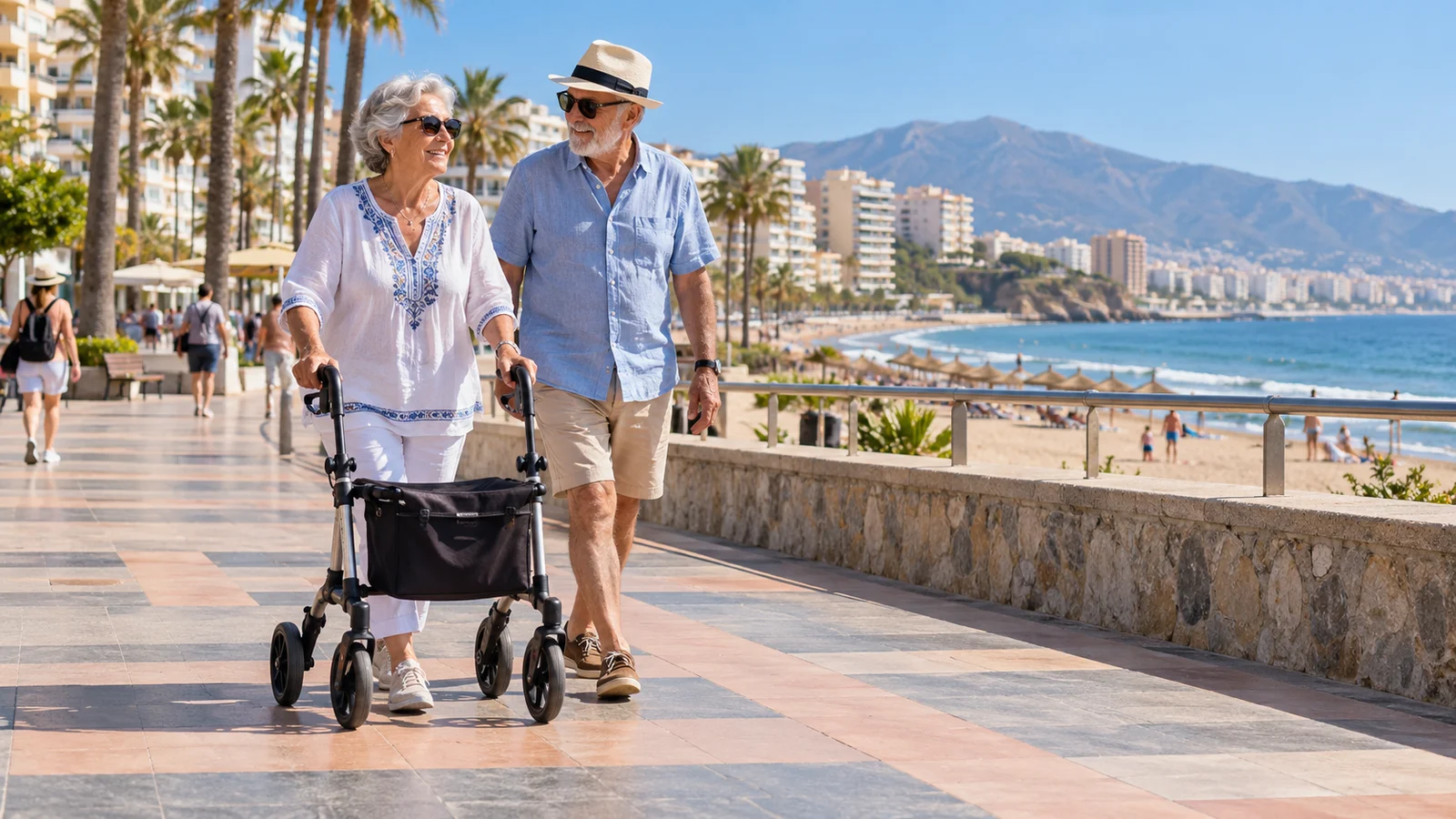
Torremolinos has real accessibility infrastructure, especially at its main beaches, but it is not a uniformly flat destination. The key is to plan the exact route rather than rely on broad labels. Coastal-level accommodation, adapted beach points, the Bajondillo lift, C1 rail and taxis can all reduce friction when combined carefully.
Quick answer
Torremolinos can work well for travellers with reduced mobility, but the town is not uniformly flat or barrier-free. The best strategy is to choose the accommodation and daily route carefully, use the accessible beach points, avoid relying on steep centre-to-coast paths, and verify station, lift and attraction access before the day you need it.
Accessible beaches
The official tourism site currently lists accessible beach infrastructure at La Carihuela, Bajondillo, Playamar and Los Álamos. The adapted areas include wide wooden walkways towards the bathing area, adapted toilets and showers, shaded areas and designated parking.
Assisted bathing
The municipality currently offers assisted bathing by appointment at the accessible beach points, with amphibious chairs and crutches and specialised staff during the defined bathing-service periods. Because the service is seasonal and appointment-based, check the current operating period and contact details before relying on it.
Which beach is easiest?
There is no single universally easiest beach. The right choice depends on where you stay and how you reach the adapted point. La Carihuela works well for travellers already based on the coast, Bajondillo is useful from the centre when the lift connection suits you, and Playamar or Los Álamos can be strong when the accommodation is close to the promenade.
Bajondillo and the centre lift
Bajondillo has the most important centre-to-coast accessibility link because the official tourism site lists a lift connecting the upper town with the beach area. This can avoid the steep Cuesta del Tajo and stairs, but lift operation should still be checked on the day if your route depends on it.
Avoid the steep historic routes
Cuesta del Tajo and stair connections can be difficult or unsuitable for many wheelchair users, people with limited balance or anyone who struggles with steep gradients. A short map distance between the centre and beach can therefore be misleading.
La Carihuela
La Carihuela is one of the easiest areas to use once you are already on the seafront level. The promenade, restaurants, beach and shops sit within a compact coastal strip. The main planning issue is the final connection from rail or upper areas.
Playamar
Playamar is a strong option for travellers who want an accessible beach-focused stay without needing to move between upper centre and coast every day. Exact hotel access still matters, so check kerbs, ramps, reception entrance and the path to the promenade.
Los Álamos
Los Álamos combines a long promenade, accessible beach services and nearby C1 stations. Official tourism information also lists the area itself as accessible. The trade-off is that the distance between a specific hotel and station can still matter.
Montemar and Parque de la Batería
Montemar is officially listed as accessible and has its own C1 stop. Parque de la Batería is nearby, and the tourism site lists accessible services there. This can make Montemar a useful base for travellers who want a quieter residential setting and a major park close by.
The promenade
The seafront promenade links the coastal areas and is one of the most useful low-gradient routes in Torremolinos. It can be much easier than repeatedly moving between the upper centre and the sea.
C1 train
Torremolinos has five C1 stations within the municipality: Los Álamos, La Colina, Torremolinos/La Nogalera, Montemar Alto and El Pinillo. The line is extremely useful for airport and regional travel, but do not assume every station route, lift or platform access is identical.
Station planning
If step-free rail access matters, check the exact station you plan to use before travelling, including lift availability, platform access and the route from accommodation to the entrance. The train itself may be useful while the final street connection remains the harder part.
Airport arrival
A direct taxi or transfer can be the simplest option when luggage, wheelchair handling, reduced stamina or an awkward final hotel route would make C1 inconvenient. If using rail, compare the complete door-to-door journey rather than only train time.
Taxis
Taxi can be an important accessibility tool in Torremolinos because it reduces steep walking and difficult last-mile connections. If you require a wheelchair-accessible vehicle, arrange and confirm the correct vehicle type in advance rather than assuming every taxi can provide it.
Bus travel
Local buses connect many areas, but accessibility can vary by vehicle, stop design and boarding conditions. Check the specific service when bus accessibility is essential to your trip.
Choosing accommodation
Do not book solely from a hotel's accessibility label. Ask about step-free entrance, lift dimensions, accessible bathroom layout, shower access, bed height, balcony threshold, pool access and the route from street or parking to reception.
Room photos are not enough
A wide bathroom in a photo does not guarantee a usable accessible bathroom. Request measurements or written confirmation when turning space, grab rails, shower layout or transfer clearance are critical.
Hotel location matters
A genuinely accessible room can still be inconvenient if the surrounding streets are steep or the promenade route has obstacles. Evaluate the building and the neighbourhood together.
Parking
If travelling by car, confirm reserved accessible spaces at the property and whether the route from the parking bay to the entrance is step-free. Beach accessibility pages also list designated parking near adapted beach zones.
Wheelchair users
For wheelchair users, coastal-level accommodation can reduce daily friction significantly. La Carihuela, Playamar and Los Álamos can be easier than a routine that repeatedly crosses the upper-centre gradient.
Reduced stamina
Travellers who can walk but tire easily should plan shorter sections and use taxi or lift strategically. A route that is technically walkable may still be unrealistic in heat or after a full day.
Walking aids
Cobbles, uneven paving, steep slopes and crowded promenades can affect travellers using sticks, crutches or rollators differently from wheelchair users. Check the exact route you expect to repeat every day.
Families and accessibility
Families combining children with mobility needs should simplify the whole chain: accommodation, beach access, meals, transport and return route. Avoid days with multiple difficult transfers.
Senior travellers
Older travellers may not identify as disabled but can still benefit from accessible planning. Reducing gradients, keeping meals close to the hotel and avoiding unnecessary uphill returns can make the trip much easier.
Heat
Heat increases the effort required for wheelchair propulsion, walking aids and reduced-stamina travel. Plan exposed outdoor routes earlier or later in the day and keep shaded recovery options nearby.
Accessible beach day
A strong accessible beach day starts with the exact adapted point, not simply the name of the beach. Confirm where the accessible entrance, shaded area, adapted toilet and assisted bathing service are located.
Bathing assistance is not automatic
The presence of an accessible beach does not mean assisted bathing is available at every moment. The current municipal service is seasonal and appointment-based, so book or confirm before making it essential to the day.
Restaurants
Restaurant accessibility varies widely. Check entrance steps, toilet access, terrace spacing and the route from promenade or street. A beachfront location does not automatically mean a step-free interior.
Attractions
For Aqualand, Crocodile Park, Molino de Inca or other attractions, check the attraction's current accessibility information directly. General destination accessibility should not be used as a substitute for attraction-specific rules.
Day trips
Málaga, Benalmádena and Fuengirola can be practical because of C1, but the accessibility of the destination station and final route still matters. Plan one simple objective rather than a multi-stop day.
Three-day stay
For a short accessible stay, choose one well-located base, one beach area, one simple C1 or taxi excursion and avoid spending the trip testing multiple difficult routes.
Seven-day stay
For a week, build a repeatable routine around an easy promenade, accessible beach point, nearby restaurants and one or two verified transport links. Predictability usually improves comfort.
What to verify before travel
Confirm hotel access, station or transfer plan, any lift you depend on, assisted-bathing arrangements, accessible parking if needed and the exact route between accommodation and your most important daily destination.
Related planning
Use the best area to stay in Torremolinos, best beaches, Torremolinos without a car, parking guide, senior guide, Torremolinos with kids, airport guide and practical guide to build the rest of the trip.
Bottom line
Torremolinos has meaningful accessible infrastructure, especially on its four main beaches and along the seafront, but the town's gradients mean route choice matters. The safest planning method is to verify the exact accommodation, adapted beach point, transport stop and lift you intend to use rather than relying on a general claim that an area is accessible.
Continue your Costa del Sol planning
Other published guides for the same destination or a closely related topic.