Accessible Nerja: realistic planning for beaches, slopes, streets and mobility
Nerja can work for travellers with mobility needs, but it should not be described as uniformly accessible. The town combines improved pedestrian areas and several adapted beach points with steep streets, uneven gradients and beaches that may involve ramps, steps or seasonal assistance. The right plan depends on the exact accommodation, the routes you intend to use and whether you need independent wheelchair access or can manage short slopes and transfers. In 2026, Nerja Town Hall continued investing in accessibility, including new and renewed mobility-reduced beach areas at Burriana, Torrecilla and El Playazo, plus urban works intended to create safer accessible pedestrian routes. ## Quick answer Nerja is most practical when you: - choose accommodation after checking the exact slope outside; - stay reasonably close to the places you will use every day; - verify whether your preferred beach has an adapted bathing point in the current season; - avoid assuming that “near the centre” means flat; - use taxi or adapted transfer when a steep final section would otherwise be difficult. For travellers who need a completely step-free environment, Nerja requires more advance checking than flatter parts of Fuengirola or Málaga. ## The town is not flat This is the first thing to understand. Nerja’s geography includes slopes between upper streets, the centre and several beach areas. A hotel can be only a few hundred metres from a beach but still involve a steep return walk. Map distance is therefore not enough. Before booking, inspect: - gradient; - kerbs; - stairs; - pavement width; - hotel entrance; - route to restaurants; - route to the beach you actually want to use. If possible, ask the accommodation directly whether a wheelchair user can travel from the entrance to the town centre without steps. ## Recent accessibility improvements Nerja Town Hall has continued accessibility works in public space. In June 2026, the municipality completed works on Calle La Fábrica and access to the El Chucho promenade. The project included renewed paving, lighting and an accessible pedestrian route linking safely with the Chíllar riverbank area. This is useful evidence of ongoing improvement, but it should not be interpreted as meaning the entire town is barrier-free. Accessibility can change street by street. ## Accessible beach points in 2026 In July 2026, Nerja Town Hall announced renewed adapted facilities at Burriana and Torrecilla and a new accessible point at El Playazo. The municipality specifically described the work as improving access to the sea for people with reduced mobility. This gives three important reference beaches for current planning: - Burriana; - Torrecilla; - El Playazo. Check the exact service before travelling because adapted bathing assistance and staffing can be seasonal. ## Burriana Burriana is one of Nerja’s best-known beaches and has a long history of municipal accessibility investment. The Town Hall previously installed adapted showers, wider walkways and reserved mobility-reduced areas there, and in 2026 again confirmed improved accessibility equipment and shade for people with reduced mobility. Burriana can therefore be a strong option if beach access is central to your trip. However, the route from some upper parts of Nerja to Burriana can be steep. A beach may have adapted facilities while the route from your hotel remains difficult. ## Torrecilla Torrecilla is another key beach for mobility-reduced facilities. The municipality confirmed renewed accessibility areas there in 2026. Its location closer to central Nerja can make it more practical for some visitors than beaches reached by steeper routes. Still, verify the exact path from your accommodation. A flat beach access point does not automatically make every nearby street easy. ## El Playazo El Playazo gained a new adapted point in 2026. That expands the accessible-beach network beyond the better-known Burriana and Torrecilla points. The municipal work also included new shade areas for people with reduced mobility during the 2026 season. Because El Playazo is a longer beach and the surrounding layout differs from central Nerja, confirm the exact access point and how you will reach it. ## Seasonal beach assistance Beach accessibility is not just about permanent ramps or walkways. It may also depend on: - lifeguard season; - amphibious chairs; - staff availability; - shade areas; - reserved zones; - accessible showers; - sea conditions. In May 2026, Nerja announced its beach surveillance and rescue service would run daily from 1 June through 27 September, with accessibility improvements included in the seasonal setup. Outside the main season, do not assume the same assisted-bathing service is operating. ## Balcón de Europa and central Nerja The central area around Balcón de Europa is one of the main visitor zones. Parts of central Nerja can be pleasant for slower walking because many streets are pedestrian or traffic-calmed. But the wider centre is not uniformly level. If Balcón de Europa is important to you, choose accommodation after checking the route rather than simply booking “Nerja centre”. A short route with a manageable gradient can be much better than a longer route with repeated climbs. ## Old-town streets Historic streets are attractive but can involve: - narrow sections; - uneven paving; - café furniture; - busy pedestrian flows; - small level changes. Travellers using wheelchairs or walkers should prioritise the simplest routes rather than trying to use every picturesque street. The best accessible itinerary is usually slightly less ambitious but much more comfortable. ## Accommodation For accessible accommodation, confirm the exact room and route. Ask: - Is the entrance step-free? - Is there a lift? - What are lift dimensions? - Is the adapted room guaranteed? - Is the shower level-access? - Are grab rails fitted? - Is there side-transfer space at the toilet? - Can the hotel send current bathroom photos? - Is the street outside steep? A hotel can have an adapted room and still be badly located for independent movement around Nerja. ## Taxi and transfer use An occasional taxi can transform a Nerja trip. If a steep section is the main barrier, using a taxi for the uphill return can make the rest of the day much easier. For wheelchair users who need an adapted vehicle, pre-arrange a suitable transfer rather than assuming one will be immediately available. Ask about: - wheelchair type; - whether transfer from chair is required; - luggage; - pickup point; - advance-booking time. ## Bus travel Nerja relies more on buses than rail because there is no Cercanías station. For regional travel, check the specific vehicle and stop rather than assuming every service has identical accessibility. The final route from the bus stop to accommodation may be more difficult than the bus journey itself. If arriving with heavy luggage or mobility equipment, a prebooked transfer may be simpler. ## Wheelchair users For a wheelchair user, the most important planning factors are: - street gradient; - kerbs; - room access; - bathroom configuration; - beach point; - taxi backup. A powered chair may handle some slopes more easily but can have different lift and vehicle requirements. A manual wheelchair user may need assistance on gradients that look modest on a map. ## Travellers using walkers or canes Nerja can be easier for travellers who can manage short slopes but need regular rests. Choose accommodation near: - cafés; - benches; - restaurants; - central pedestrian streets; - preferred beach. Avoid itineraries that require repeated down-and-up movement between town and beaches. ## Visual or sensory accessibility Physical mobility is only one aspect of accessibility. Travellers may also need: - clear signage; - quiet accommodation; - visual alarms; - hearing support; - easy communication; - predictable routes. Ask the accommodation directly about any essential feature. Do not assume an “accessible” room covers sensory requirements. ## Accessible toilets Do not rely on a generic map icon. If an accessible toilet is important during a beach or town visit, confirm current facilities at the exact venue or beach point. Public facilities can have opening hours or seasonal availability. ## Parking If you drive, check whether the accommodation has a reserved accessible bay. Street parking in central Nerja can be difficult, especially in busy periods. Ask: - whether the bay can be reserved; - distance to entrance; - gradient; - garage lift; - height limits; - route from parking to room. ## Heat Summer heat can make mobility much harder. Plan shorter distances during the hottest hours. Shade, water and easy access back to accommodation matter more for travellers who move slowly or tire more quickly. A route that is manageable at 09:00 may feel much harder at 15:00 in August. ## A practical accessible day A lower-friction day might look like: - breakfast near the hotel; - taxi or easy route to Burriana/Torrecilla; - use the adapted beach point; - lunch nearby; - return before the hottest period; - central evening walk on the easiest pedestrian streets. The goal is not to maximise distance. It is to make the destination enjoyable without spending the day solving barriers. ## When Nerja is a good fit Nerja can be a good choice if: - you value smaller-town atmosphere; - you are happy to use occasional taxis; - you choose the hotel carefully; - one of the current adapted beach points meets your needs; - you do not require every route to be completely flat. ## When another base may be easier Consider Fuengirola, central Málaga or parts of Torremolinos if you need: - flatter everyday movement; - direct rail; - easier airport connection; - less dependence on taxis. Nerja should be chosen because you want Nerja, not because it is the simplest mobility destination on the Costa del Sol. ## Before booking Confirm: 1. exact accommodation entrance; 2. bathroom; 3. street gradient; 4. nearest usable beach; 5. current adapted-beach service; 6. taxi/transfer backup; 7. bus-stop route; 8. heat/shade plan; 9. accessible parking if driving; 10. any sensory requirements. ## Sources - Ayuntamiento de Nerja — 2026 accessibility improvements at Burriana, Torrecilla and El Playazo. - Ayuntamiento de Nerja — 2026 beach surveillance and accessibility service. - Ayuntamiento de Nerja — 2026 accessible pedestrian improvements at Calle La Fábrica and El Chucho. - Ayuntamiento de Nerja — municipal accessibility planning and earlier adapted beach equipment. Accessibility services and seasonal assistance can change. Confirm current details before travelling.
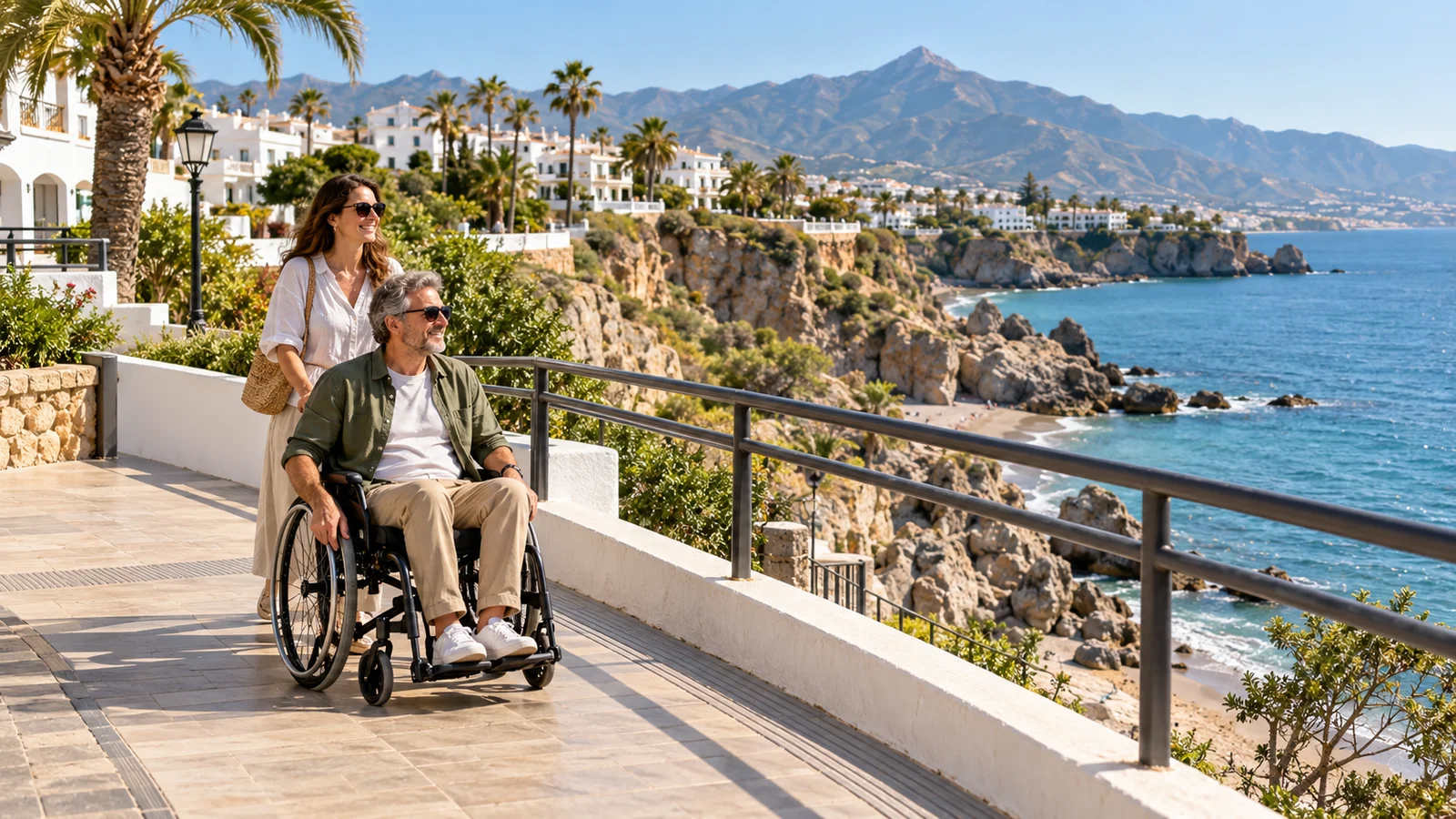
Nerja can work for travellers with mobility needs, but it should not be described as uniformly accessible.
The town combines improved pedestrian areas and several adapted beach points with steep streets, uneven gradients and beaches that may involve ramps, steps or seasonal assistance. The right plan depends on the exact accommodation, the routes you intend to use and whether you need independent wheelchair access or can manage short slopes and transfers.
In 2026, Nerja Town Hall continued investing in accessibility, including new and renewed mobility-reduced beach areas at Burriana, Torrecilla and El Playazo, plus urban works intended to create safer accessible pedestrian routes.
Quick answer
Nerja is most practical when you:
- choose accommodation after checking the exact slope outside;
- stay reasonably close to the places you will use every day;
- verify whether your preferred beach has an adapted bathing point in the current season;
- avoid assuming that “near the centre” means flat;
- use taxi or adapted transfer when a steep final section would otherwise be difficult.
For travellers who need a completely step-free environment, Nerja requires more advance checking than flatter parts of Fuengirola or Málaga.
The town is not flat
This is the first thing to understand.
Nerja’s geography includes slopes between upper streets, the centre and several beach areas.
A hotel can be only a few hundred metres from a beach but still involve a steep return walk.
Map distance is therefore not enough.
Before booking, inspect:
- gradient;
- kerbs;
- stairs;
- pavement width;
- hotel entrance;
- route to restaurants;
- route to the beach you actually want to use.
If possible, ask the accommodation directly whether a wheelchair user can travel from the entrance to the town centre without steps.
Recent accessibility improvements
Nerja Town Hall has continued accessibility works in public space.
In June 2026, the municipality completed works on Calle La Fábrica and access to the El Chucho promenade. The project included renewed paving, lighting and an accessible pedestrian route linking safely with the Chíllar riverbank area.
This is useful evidence of ongoing improvement, but it should not be interpreted as meaning the entire town is barrier-free.
Accessibility can change street by street.
Accessible beach points in 2026
In July 2026, Nerja Town Hall announced renewed adapted facilities at Burriana and Torrecilla and a new accessible point at El Playazo.
The municipality specifically described the work as improving access to the sea for people with reduced mobility.
This gives three important reference beaches for current planning:
- Burriana;
- Torrecilla;
- El Playazo.
Check the exact service before travelling because adapted bathing assistance and staffing can be seasonal.
Burriana
Burriana is one of Nerja’s best-known beaches and has a long history of municipal accessibility investment.
The Town Hall previously installed adapted showers, wider walkways and reserved mobility-reduced areas there, and in 2026 again confirmed improved accessibility equipment and shade for people with reduced mobility.
Burriana can therefore be a strong option if beach access is central to your trip.
However, the route from some upper parts of Nerja to Burriana can be steep.
A beach may have adapted facilities while the route from your hotel remains difficult.
Torrecilla
Torrecilla is another key beach for mobility-reduced facilities.
The municipality confirmed renewed accessibility areas there in 2026.
Its location closer to central Nerja can make it more practical for some visitors than beaches reached by steeper routes.
Still, verify the exact path from your accommodation.
A flat beach access point does not automatically make every nearby street easy.
El Playazo
El Playazo gained a new adapted point in 2026.
That expands the accessible-beach network beyond the better-known Burriana and Torrecilla points.
The municipal work also included new shade areas for people with reduced mobility during the 2026 season.
Because El Playazo is a longer beach and the surrounding layout differs from central Nerja, confirm the exact access point and how you will reach it.
Seasonal beach assistance
Beach accessibility is not just about permanent ramps or walkways.
It may also depend on:
- lifeguard season;
- amphibious chairs;
- staff availability;
- shade areas;
- reserved zones;
- accessible showers;
- sea conditions.
In May 2026, Nerja announced its beach surveillance and rescue service would run daily from 1 June through 27 September, with accessibility improvements included in the seasonal setup.
Outside the main season, do not assume the same assisted-bathing service is operating.
Balcón de Europa and central Nerja
The central area around Balcón de Europa is one of the main visitor zones.
Parts of central Nerja can be pleasant for slower walking because many streets are pedestrian or traffic-calmed.
But the wider centre is not uniformly level.
If Balcón de Europa is important to you, choose accommodation after checking the route rather than simply booking “Nerja centre”.
A short route with a manageable gradient can be much better than a longer route with repeated climbs.
Old-town streets
Historic streets are attractive but can involve:
- narrow sections;
- uneven paving;
- café furniture;
- busy pedestrian flows;
- small level changes.
Travellers using wheelchairs or walkers should prioritise the simplest routes rather than trying to use every picturesque street.
The best accessible itinerary is usually slightly less ambitious but much more comfortable.
Accommodation
For accessible accommodation, confirm the exact room and route.
Ask:
- Is the entrance step-free?
- Is there a lift?
- What are lift dimensions?
- Is the adapted room guaranteed?
- Is the shower level-access?
- Are grab rails fitted?
- Is there side-transfer space at the toilet?
- Can the hotel send current bathroom photos?
- Is the street outside steep?
A hotel can have an adapted room and still be badly located for independent movement around Nerja.
Taxi and transfer use
An occasional taxi can transform a Nerja trip.
If a steep section is the main barrier, using a taxi for the uphill return can make the rest of the day much easier.
For wheelchair users who need an adapted vehicle, pre-arrange a suitable transfer rather than assuming one will be immediately available.
Ask about:
- wheelchair type;
- whether transfer from chair is required;
- luggage;
- pickup point;
- advance-booking time.
Bus travel
Nerja relies more on buses than rail because there is no Cercanías station.
For regional travel, check the specific vehicle and stop rather than assuming every service has identical accessibility.
The final route from the bus stop to accommodation may be more difficult than the bus journey itself.
If arriving with heavy luggage or mobility equipment, a prebooked transfer may be simpler.
Wheelchair users
For a wheelchair user, the most important planning factors are:
- street gradient;
- kerbs;
- room access;
- bathroom configuration;
- beach point;
- taxi backup.
A powered chair may handle some slopes more easily but can have different lift and vehicle requirements.
A manual wheelchair user may need assistance on gradients that look modest on a map.
Travellers using walkers or canes
Nerja can be easier for travellers who can manage short slopes but need regular rests.
Choose accommodation near:
- cafés;
- benches;
- restaurants;
- central pedestrian streets;
- preferred beach.
Avoid itineraries that require repeated down-and-up movement between town and beaches.
Visual or sensory accessibility
Physical mobility is only one aspect of accessibility.
Travellers may also need:
- clear signage;
- quiet accommodation;
- visual alarms;
- hearing support;
- easy communication;
- predictable routes.
Ask the accommodation directly about any essential feature.
Do not assume an “accessible” room covers sensory requirements.
Accessible toilets
Do not rely on a generic map icon.
If an accessible toilet is important during a beach or town visit, confirm current facilities at the exact venue or beach point.
Public facilities can have opening hours or seasonal availability.
Parking
If you drive, check whether the accommodation has a reserved accessible bay.
Street parking in central Nerja can be difficult, especially in busy periods.
Ask:
- whether the bay can be reserved;
- distance to entrance;
- gradient;
- garage lift;
- height limits;
- route from parking to room.
Heat
Summer heat can make mobility much harder.
Plan shorter distances during the hottest hours.
Shade, water and easy access back to accommodation matter more for travellers who move slowly or tire more quickly.
A route that is manageable at 09:00 may feel much harder at 15:00 in August.
A practical accessible day
A lower-friction day might look like:
- breakfast near the hotel;
- taxi or easy route to Burriana/Torrecilla;
- use the adapted beach point;
- lunch nearby;
- return before the hottest period;
- central evening walk on the easiest pedestrian streets.
The goal is not to maximise distance.
It is to make the destination enjoyable without spending the day solving barriers.
When Nerja is a good fit
Nerja can be a good choice if:
- you value smaller-town atmosphere;
- you are happy to use occasional taxis;
- you choose the hotel carefully;
- one of the current adapted beach points meets your needs;
- you do not require every route to be completely flat.
When another base may be easier
Consider Fuengirola, central Málaga or parts of Torremolinos if you need:
- flatter everyday movement;
- direct rail;
- easier airport connection;
- less dependence on taxis.
Nerja should be chosen because you want Nerja, not because it is the simplest mobility destination on the Costa del Sol.
Before booking
Confirm:
- exact accommodation entrance;
- bathroom;
- street gradient;
- nearest usable beach;
- current adapted-beach service;
- taxi/transfer backup;
- bus-stop route;
- heat/shade plan;
- accessible parking if driving;
- any sensory requirements.
Sources
- Ayuntamiento de Nerja — 2026 accessibility improvements at Burriana, Torrecilla and El Playazo.
- Ayuntamiento de Nerja — 2026 beach surveillance and accessibility service.
- Ayuntamiento de Nerja — 2026 accessible pedestrian improvements at Calle La Fábrica and El Chucho.
- Ayuntamiento de Nerja — municipal accessibility planning and earlier adapted beach equipment.
Accessibility services and seasonal assistance can change. Confirm current details before travelling.
Continue your Costa del Sol planning
Other published guides for the same destination or a closely related topic.